
Mr Softwash®
The Original Soft Washing Company
"K Rend Render, Silicone Renders & Soft Washing Specialist"
Mr Softwash®
The Original Soft Washing Company
"K Rend Render, Silicone Renders & Soft Washing Specialist"
Award-Winning
Silicone Render Cleaning
Specialist.
K Rend | Monocouche | Parex
✅ 30+ years Experience
✅ 5 Star ⭐️ Google Reviews
✅ £5 Million Insurance
✅ Free Written Quote - No Obligation
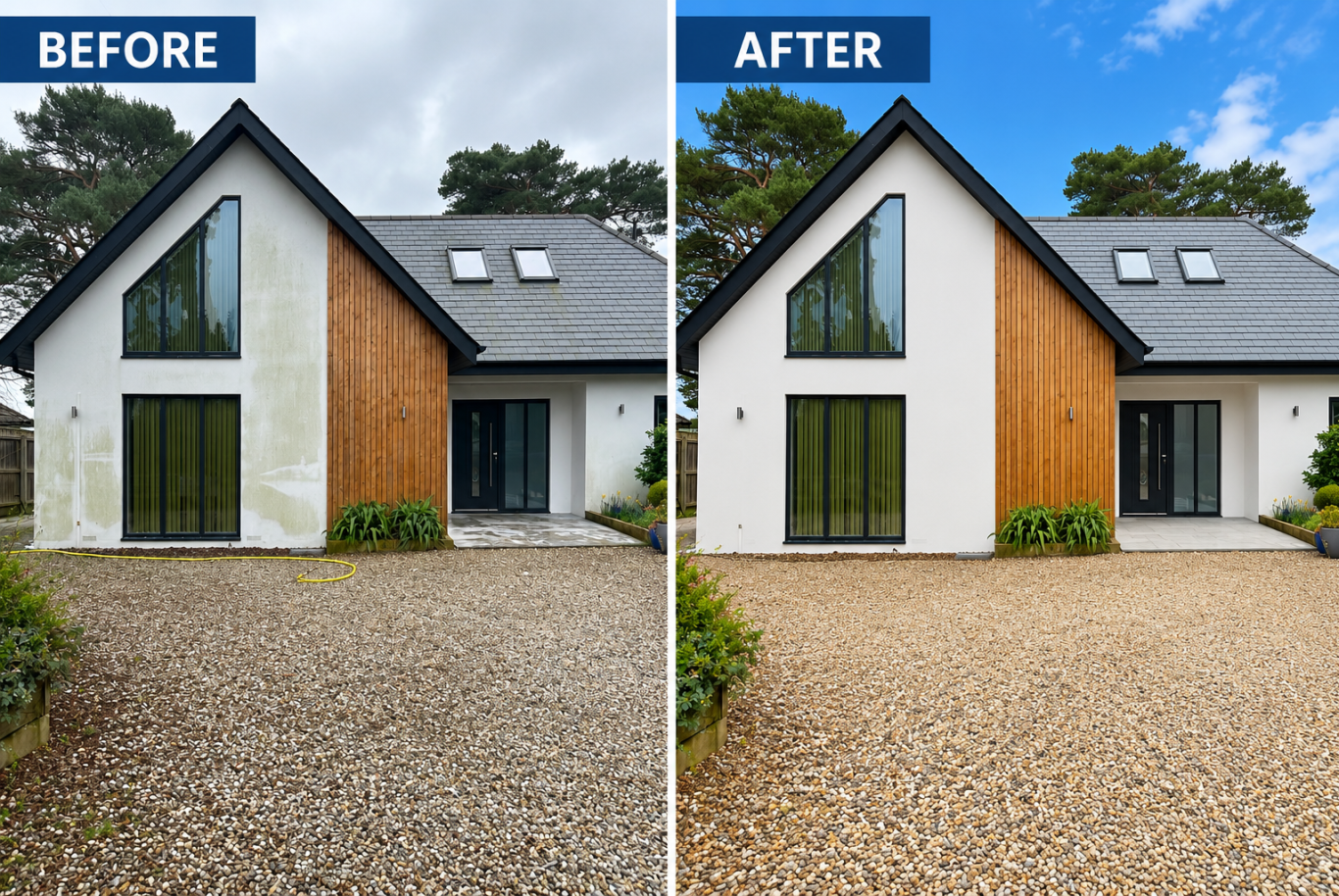
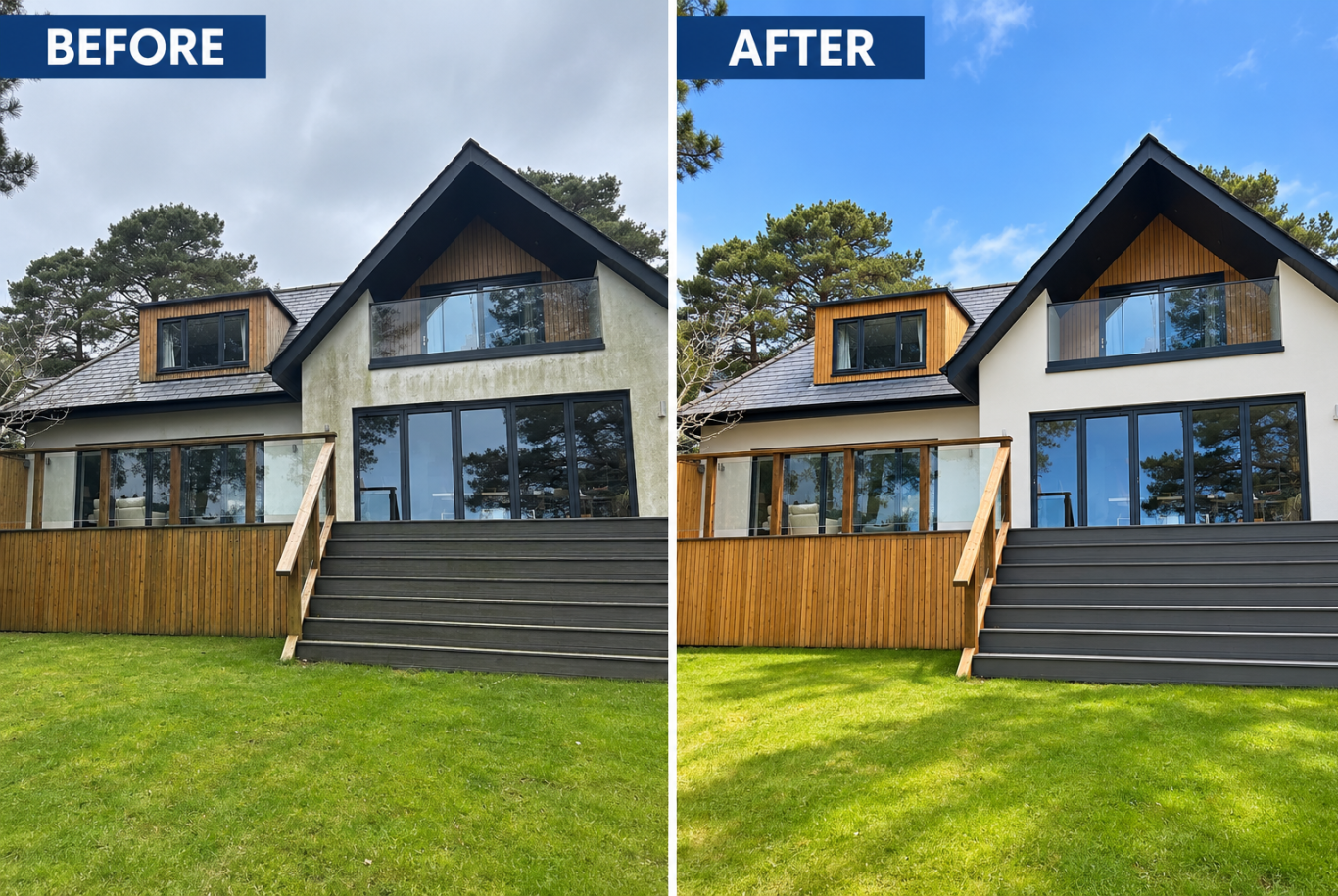
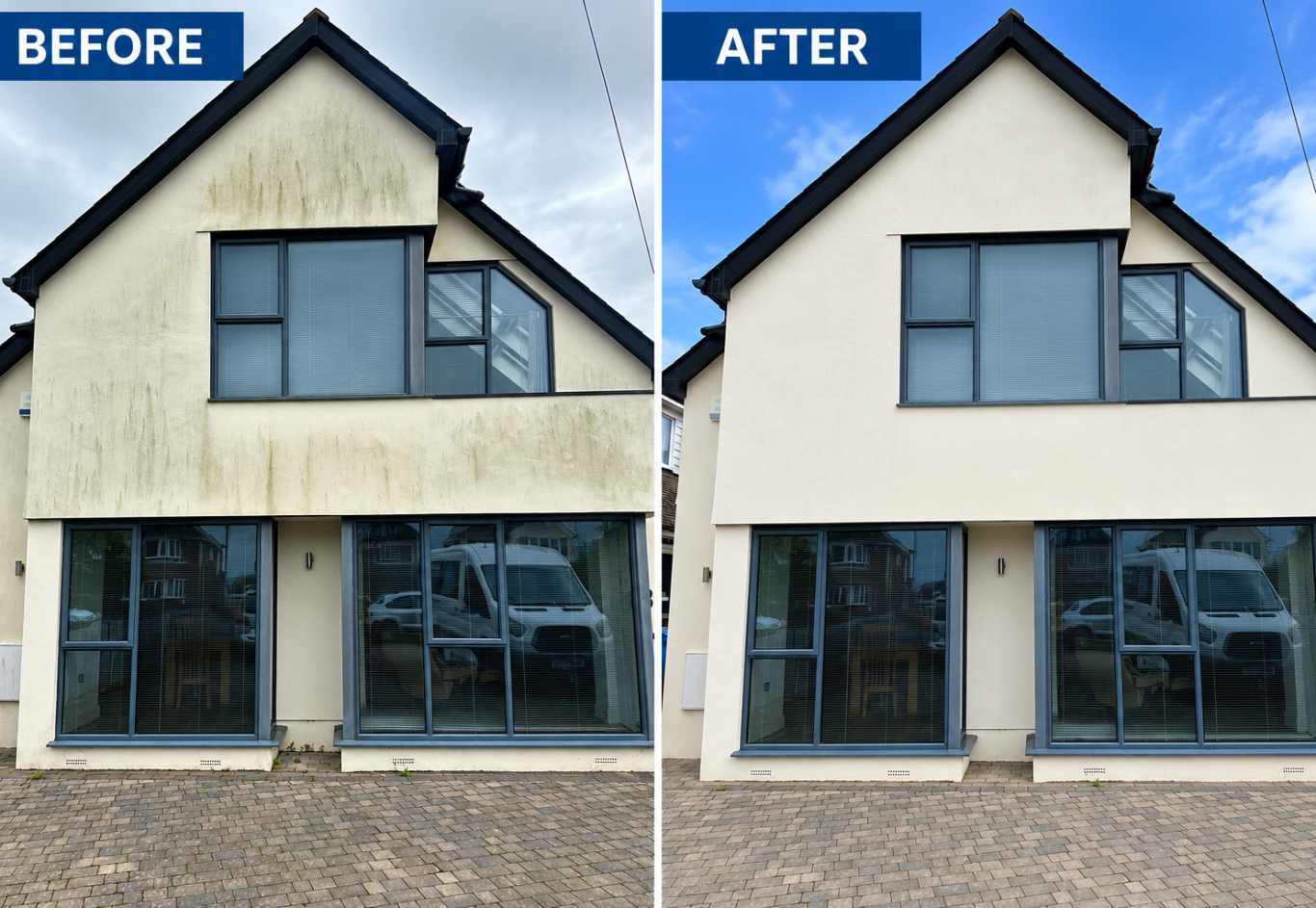
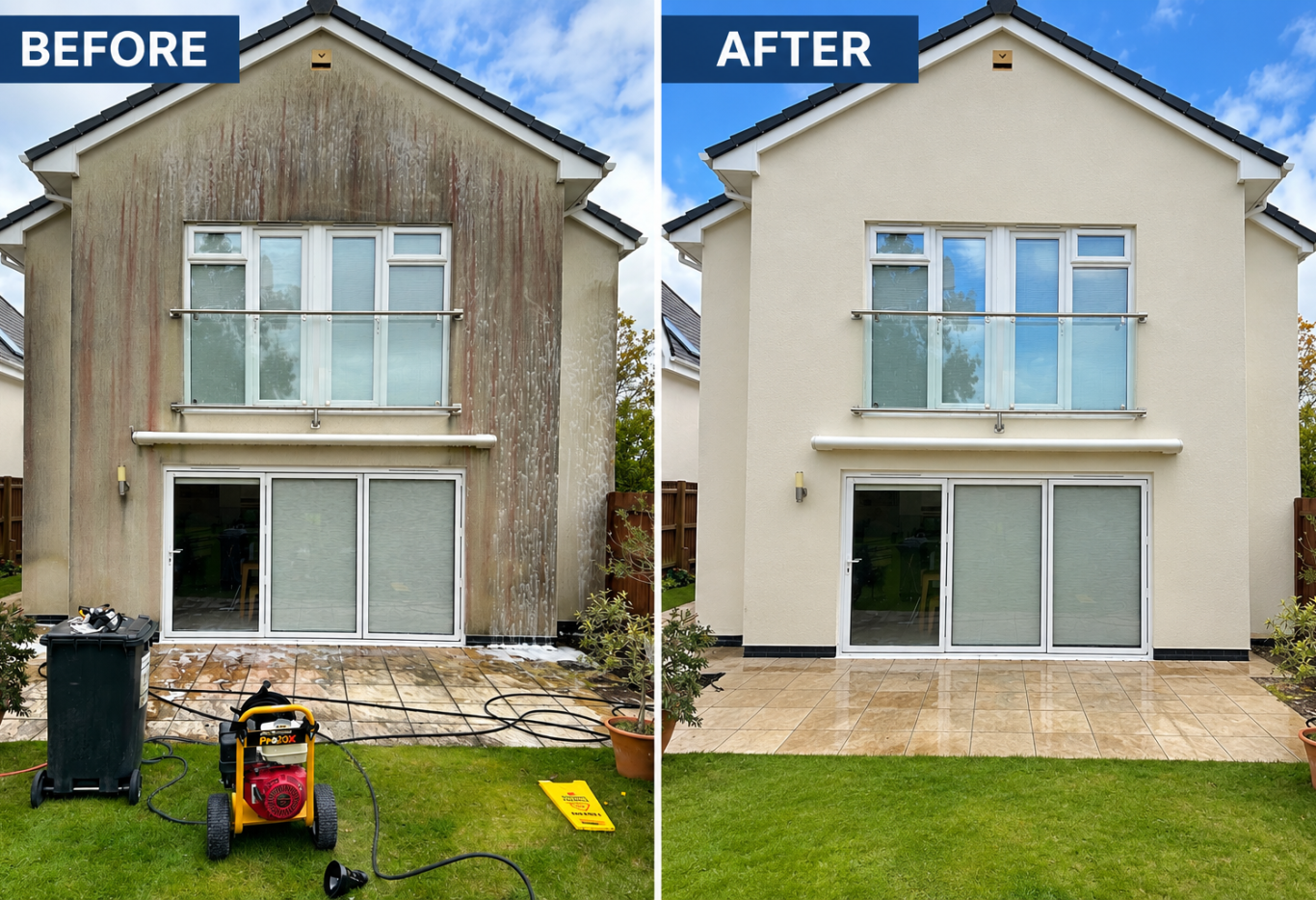
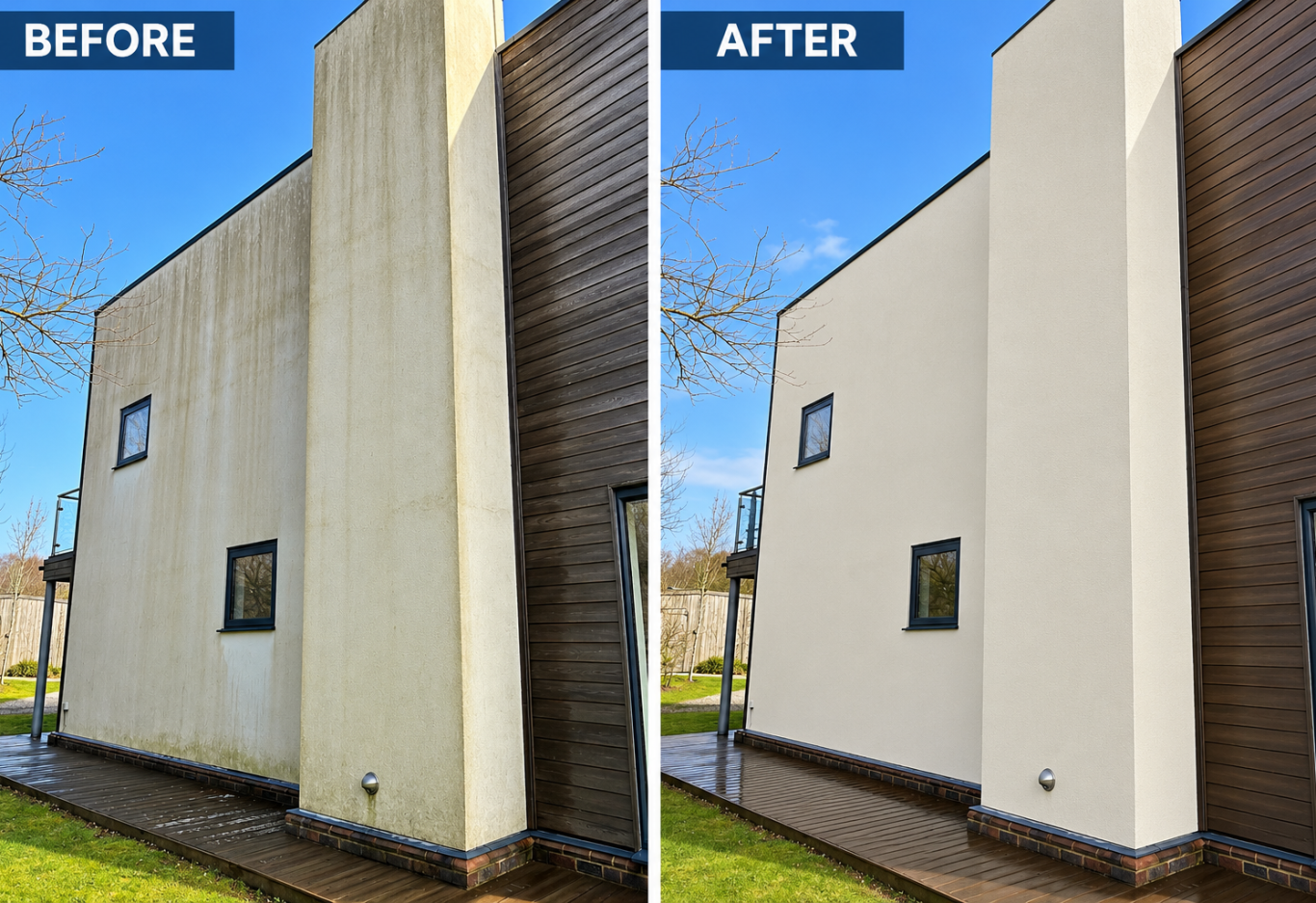
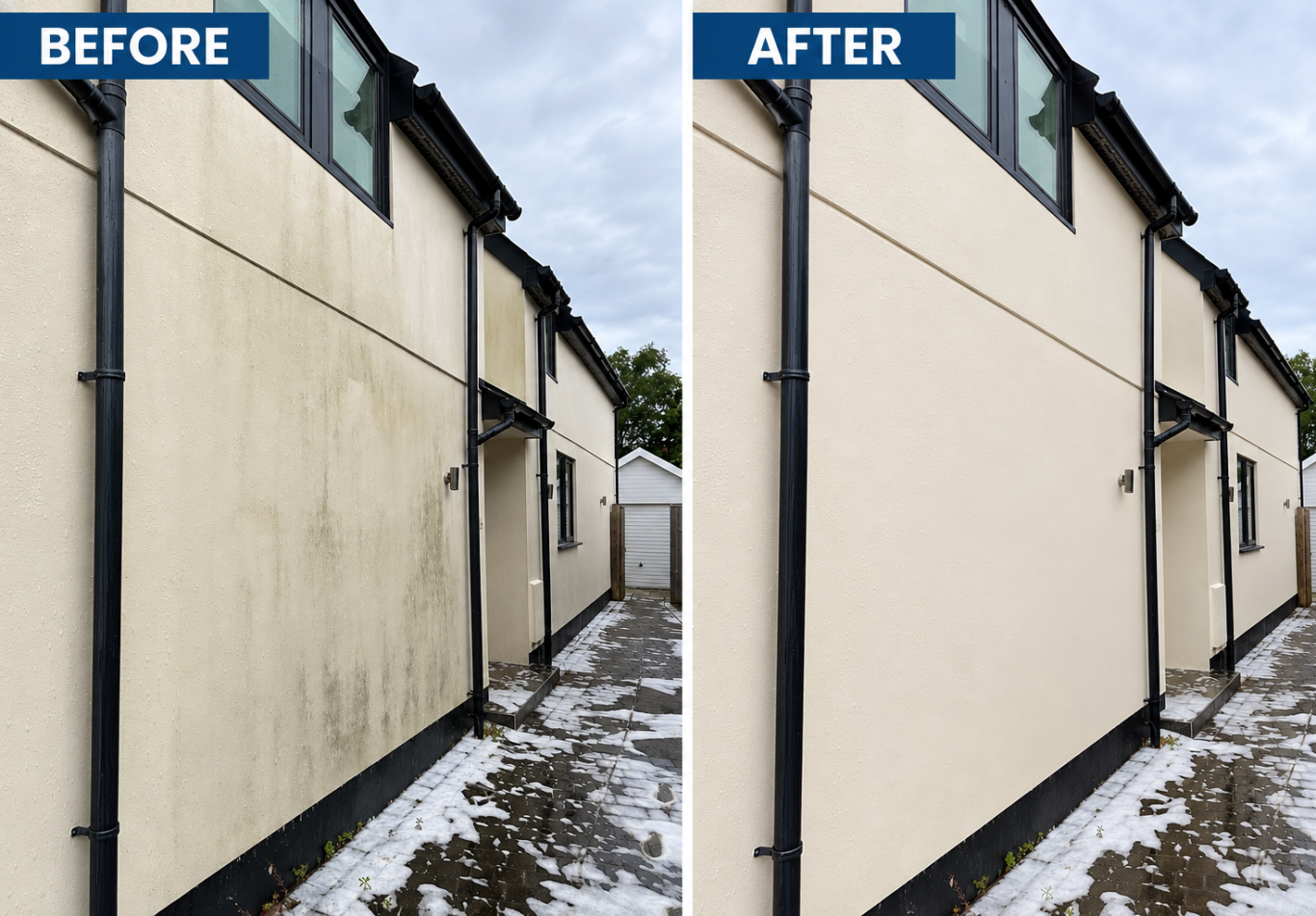
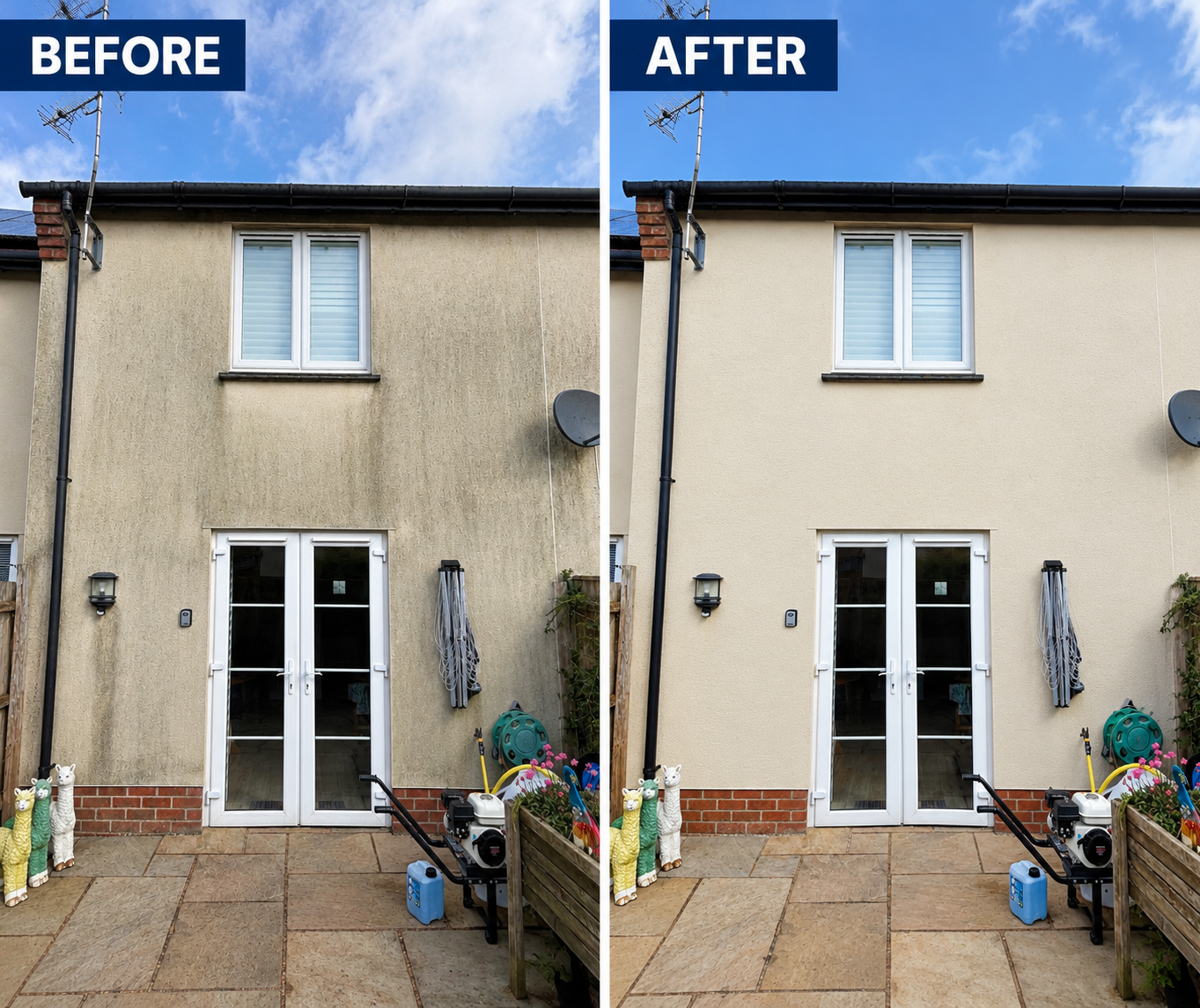
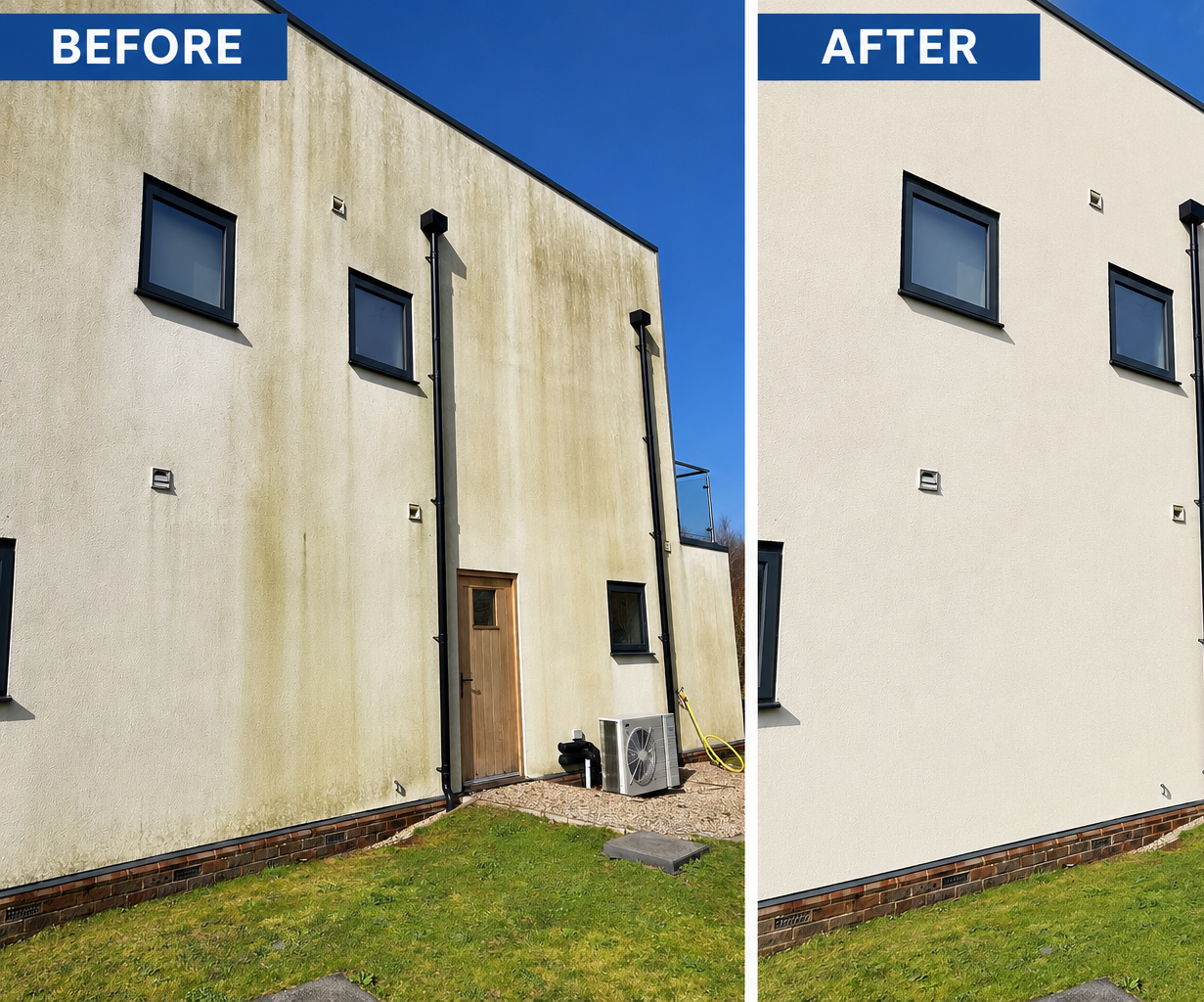
When silicone-based renders start showing ugly red algae, black mold, or environmental staining, aggressive high-pressure washing often causes expensive surface damage. Mr Softwash delivers a specialized, low-pressure softwashing solution designed specifically to restore render without compromising its structural integrity. By combining gentle water pressure with targeted, eco-friendly biocide treatments, Mr Softwash sanitizes surfaces at the root level—killing organic growth rather than just blasting away surface dirt. Mr Softwash’s specialised non-abrasive method guarantees a longer-lasting clean, protecting your property’s curb appeal and preserving your render from further contamination for 3-5 years.
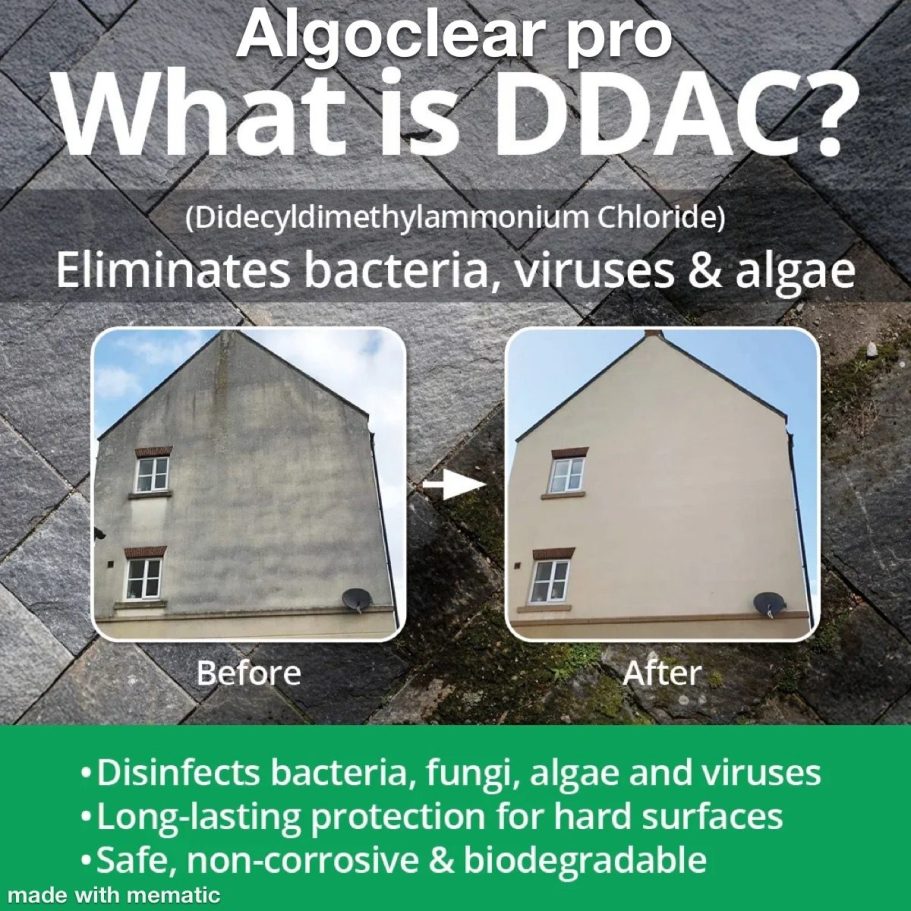
K Rend market their own K Rend cleaning product called K Rend Render Clean. (Previously known as K Rend Algae Clean)
K Rend Render Clean is an eco- friendly biocide cleaning product which is a great product for cleaning renders safely without the risks associated with using sodium hydrochlorite (Bleach) or the high heat with steam cleaning.
Mr Softwash uses biocide render cleaning products such as K Rend Render Clean and other DDAC products as we have found it's the safest way to clean and protect renders without damaging them, giving results lasting for up to 3-5 years.
K Rend & Render cleaning with DDAC
Don't let stained and weathered render spoil the appearance of your property.
For professional Silicone Render cleaning in Poole, Dorset and Hampshire, contact Mr Softwash today for a free online quote.
WhatsApp a photo & postcode to get a free quote




The Complete Guide to Silicone Render: Types, Cleaning and Maintenance
Everything You Need to Know About Silicone Render
Silicone render has become one of the most popular exterior wall finishes for modern homes, extensions, commercial buildings and renovation projects throughout the UK.
Known for its attractive appearance, water-repellent properties and relatively low maintenance requirements, silicone render provides a durable decorative finish that can protect and enhance a building's exterior.
However, despite often being marketed as low maintenance, silicone render is not maintenance-free.
Over time, silicone-rendered surfaces can develop green algae, black staining, red or pink biological growth, dirt deposits and other forms of environmental contamination.
Understanding the different types of silicone render, how they work, why they become discoloured and how to clean them correctly is essential for maintaining their appearance and extending their service life.
At Mr Softwash, we specialise in professional render cleaning and soft washing throughout Poole, Bournemouth, Christchurch, Dorset and Hampshire.
This comprehensive guide explains everything property owners should know about silicone render, from its composition and installation to specialist cleaning techniques and preventative maintenance.
1. What Is Silicone Render?
Silicone render is a modern decorative exterior wall coating containing silicone-based water-repellent additives.
It is designed to provide an attractive, weather-resistant finish while allowing water vapour to escape through the render system.
Unlike traditional sand and cement render, many modern silicone renders are supplied as factory-prepared, ready-to-use products.
They are commonly applied as the finishing coat over a compatible basecoat or reinforced render system.
Silicone render is particularly popular for:
Modern residential properties
New-build housing developments
Home extensions
Renovated properties
External wall insulation systems
Commercial buildings
Coastal properties
Contemporary architectural projects
What Makes Silicone Render Different?
The primary distinguishing characteristic of silicone render is its combination of water repellency and vapour permeability.
Water repellency: Silicone additives reduce the amount of liquid water absorbed by the surface.
Vapour permeability: The render can allow moisture in vapour form to pass through the coating, helping the wall system manage moisture.
Flexibility: Many silicone-based thin-coat systems offer greater flexibility than traditional rigid cement renders.
Colour retention: Quality silicone renders are formulated to provide a long-lasting decorative finish, although colour stability varies between products.
Reduced water absorption: Rainwater tends to run off rather than readily soaking into the surface.
However, these properties do not make silicone render completely waterproof, immune to staining or resistant to all biological growth.
2. What Are the Different Types of Silicone Render?
Not all products described as silicone render are the same.
Different manufacturers use different formulations, binders, aggregates and additives.
Some products are predominantly silicone-resin based, while others combine silicone with acrylic or other polymer binders.
Understanding these differences is important when choosing a render system and determining the safest cleaning method.
2.1 Silicone Resin Render
Silicone resin render is a decorative thin-coat render containing silicone resin or silicone-based additives.
It is one of the most common modern render finishes used on residential and commercial properties.
Main characteristics
Water-repellent surface
Good vapour permeability
Available in numerous colours
Typically supplied ready to use
Available in different aggregate sizes
Suitable for compatible render and insulation systems
Designed to resist normal weather exposure
Common applications
Silicone resin render is widely used on modern homes, extensions, commercial properties and external wall insulation systems.
Cleaning considerations
Although silicone resin render is water-repellent, algae and other biological contamination can still colonise its textured surface.
A carefully selected soft washing treatment can often remove this contamination without the aggressive mechanical action associated with high-pressure washing.
The cleaning chemistry must be compatible with the particular product and its condition.
2.2 Silicone-Silicate Render
Silicone-silicate render combines characteristics of silicone-based and silicate-based render technologies.
Depending on the formulation, it can provide good vapour permeability, water repellency and durability.
Main characteristics
Good moisture vapour permeability
Water-repellent properties
Mineral-compatible formulations
Decorative textured finish
Suitable for specified masonry and render systems
Cleaning considerations
The correct cleaning method depends on the manufacturer's formulation.
Some silicate-containing finishes may react differently to cleaning chemicals than conventional silicone resin renders.
Manufacturer guidance should therefore be checked before chemical treatment.
2.3 Silicone-Acrylic Render
Some decorative renders combine silicone-based additives with acrylic polymer binders.
These hybrid formulations are designed to balance flexibility, adhesion, weather resistance and water repellency.
Main characteristics
Flexible decorative coating
Water-repellent additives
Wide colour selection
Good adhesion to compatible substrates
Available in textured finishes
Cleaning considerations
Silicone-acrylic renders can be vulnerable to inappropriate chemical concentrations, excessive dwell times and aggressive pressure washing.
Cleaning should begin with an assessment of the coating and a small compatibility test.
2.4 Silicone Thin-Coat Render
Thin-coat render describes a render system or finishing method rather than a completely separate chemical category.
Many silicone renders are applied as thin decorative finishing coats over reinforced basecoats.
The finish is commonly applied at a thickness broadly corresponding to the aggregate size, although exact application thickness depends on the manufacturer's specification.
Main characteristics
Lightweight decorative finish
Consistent factory-produced texture
Available in numerous colours
Commonly used with external wall insulation
Applied over a prepared basecoat
Cleaning considerations
Thin-coat render requires particular care because its decorative finishing layer can be relatively thin.
Aggressive pressure washing may damage the surface, remove texture or force water into defects.
2.5 Silicone Render Used with External Wall Insulation
External wall insulation, commonly called EWI, consists of insulation boards fixed to external walls and covered with a reinforced basecoat and decorative finish.
Silicone render is frequently used as the final decorative coating.
Main characteristics
Compatible with specified insulation systems
Provides an attractive decorative finish
Helps protect the underlying system from weather exposure
Available in numerous textures and colours
Cleaning considerations
External wall insulation systems require particular care.
Excessive water pressure can damage the decorative coating, disturb joints or introduce moisture into vulnerable areas.
Before cleaning, inspect the system for cracks, impact damage, failed seals and other defects.
Any cleaning method must be compatible with the complete EWI system, not just the outer render.
3. Popular Silicone Render Manufacturers in the UK
Several manufacturers supply silicone-based render products to the UK construction market.
Well-known names include:
K Rend: Offers silicone-based render systems, including silicone thin-coat and other silicone render products.
Weber: Supplies decorative render systems, including silicone-based finishes.
Sto: Produces specialist façade coatings and render systems, including silicone resin products.
Baumit: Offers silicone render finishes for compatible façade systems.
EWI Pro: Supplies silicone render products and external wall insulation materials.
Parex: Provides a range of decorative façade render systems, including silicone-based products.
Important: Products within the same manufacturer's range can have significantly different compositions and cleaning requirements.
Always identify the exact product where possible rather than relying solely on the manufacturer's name.
4. Silicone Render Textures and Finishes
Silicone render is available in different textures, grain sizes and decorative finishes.
The texture influences appearance, dirt retention and cleaning requirements.
4.1 Fine-Textured Silicone Render
Fine-textured silicone render produces a relatively smooth, uniform finish.
Common aggregate sizes may include approximately 1.0 mm or 1.5 mm, depending on the manufacturer.
Advantages
Contemporary appearance
Uniform decorative finish
Popular on modern properties
Cleaning considerations
Fine-textured surfaces can show streaking, patchy contamination and uneven cleaning more readily.
Consistent application and rinsing techniques are important.
4.2 Medium-Textured Silicone Render
Medium-textured silicone render often uses aggregate sizes around 1.5–2.0 mm.
It provides a balance between decorative texture and a relatively uniform finish.
Cleaning considerations
Small surface recesses can retain airborne dirt, algae and organic debris.
Professional soft washing can help treat contamination within the texture.
4.3 Coarse-Textured Silicone Render
Coarse-textured silicone render uses larger aggregates to produce a more pronounced surface texture.
Advantages
Distinctive decorative appearance
Can help disguise minor visual imperfections
Suitable for selected architectural styles
Cleaning considerations
Deeper surface texture may retain more dirt and biological material.
Cleaning solutions must reach the recesses without damaging the coating.
4.4 Scraped, Rolled and Other Decorative Finishes
The appearance of silicone render can also depend on the application method.
Common decorative effects include:
Scraped-effect finishes
Rolled or floated textures
Fine-grain finishes
Coarse-grain finishes
Bespoke architectural textures
The available finishes vary by product.
Some traditional scraped finishes are associated with thicker monocouche renders rather than conventional silicone thin-coat systems.
5. Silicone Render vs Acrylic Render vs Mineral Render
Understanding the differences between render types is essential for correct maintenance.
Feature
Silicone Render
Acrylic Render
Mineral Render
Main binder
Silicone resin or silicone-modified binder
Acrylic polymer
Mineral binder, often cementitious
Water repellency
Generally high
Product-dependent
Product-dependent
Vapour permeability
Generally good
Varies by formulation
Often high
Flexibility
Generally good
Generally good
Typically more rigid
Colour options
Extensive
Extensive
Product-dependent
Biological growth
Possible
Possible
Possible
Pressure washing
Requires caution
Requires caution
Requires caution
Soft washing
Often suitable after assessment
Often suitable after assessment
Product-specific assessment needed
Maintenance
Periodic inspection and cleaning
Periodic inspection and cleaning
Periodic inspection and cleaning
No render type is completely maintenance-free.
The condition of the building, local environment, installation quality and maintenance history can be as important as the render formulation.
6. Why Does Silicone Render Become Dirty?
One of the most common misconceptions is that silicone render cannot become dirty because it is water-repellent.
In reality, silicone render remains exposed to airborne pollution, biological spores, organic debris and weathering.
Several factors contribute to discolouration.
6.1 Airborne Contamination
Dust, vehicle emissions, pollen and airborne particles settle on exterior walls.
Over time, these deposits can create visible staining.
Properties near busy roads and urban areas may experience greater atmospheric contamination.
6.2 Moisture Retention
Although silicone render repels liquid water, moisture can remain on the surface or within textured recesses.
Damp conditions create opportunities for algae and other microorganisms to develop.
6.3 Shaded Elevations
North-facing walls and areas shaded by trees or neighbouring buildings often remain damp for longer.
These areas may develop biological contamination faster than walls exposed to direct sunlight.
6.4 Trees and Vegetation
Nearby vegetation can contribute to contamination through:
Organic debris
Pollen
Shading
Restricted airflow
Increased local humidity
6.5 Coastal Conditions
Properties throughout Poole, Bournemouth, Christchurch and the Dorset coastline are exposed to coastal weather conditions.
Wind-driven rain, airborne salts, moisture and organic deposits can influence the appearance and condition of exterior render.
Salt deposits should be distinguished from biological contamination before treatment.
6.6 Building Design
Architectural features can influence how quickly render becomes dirty.
Common contributing factors include:
Inadequate roof overhangs
Leaking gutters
Poorly positioned downpipes
Defective window seals
Insufficient drip details
Water running repeatedly down the same areas
Correcting these issues can be more important than repeatedly cleaning the affected render.
7. Common Types of Silicone Render Staining
Different stains require different cleaning methods.
Correct identification is essential before applying any chemical treatment.
7.1 Green Algae on Silicone Render
Green algae is one of the most common forms of biological contamination found on exterior render.
It often develops in damp or shaded areas.
Common signs
Green patches
Green streaks
Widespread green discolouration
Heavier growth beneath window ledges or rooflines
Why it develops
Algae can grow where sufficient moisture, light and nutrients are available.
How it is removed
A suitable professional biocidal or cleaning treatment may be used to control and remove algae.
Treatment should follow product instructions and be compatible with the render.
Depending on the treatment and contamination, controlled rinsing or a subsequent cleaning stage may be required.
7.2 Black Staining on Silicone Render
Black staining is another common problem.
However, not all black staining is caused by the same organism or contaminant.
Possible causes include:
Dark biological growth
Fungal contamination
Cyanobacteria
Airborne pollution
Soot
Embedded environmental deposits
Why identification matters
A treatment effective against algae may not remove deeply embedded atmospheric staining.
Some black discolouration may also be associated with permanent changes to the coating.
Cleaning approach
Professional assessment should determine whether the staining is biological, environmental or a combination of both.
A suitable cleaning treatment may then be applied, followed by controlled rinsing where appropriate.
7.3 Red and Pink Staining
Red or pink discolouration can occur on rendered surfaces.
Possible causes include pigmented microorganisms, including certain algae and other biological organisms.
However, colour alone cannot reliably identify the cause.
Cleaning approach
A compatible biological cleaning treatment may help remove the growth.
Persistent staining may require further investigation.
7.4 Lichen Growth
Lichens are composite organisms that can attach firmly to exterior surfaces.
They may appear as grey, green, yellow or dark patches.
Lichen can be more difficult to remove than light surface algae.
Cleaning considerations
Aggressive scraping should be avoided because it can damage the decorative finish.
Suitable biological treatment and sufficient time may help loosen or control growth.
7.5 Moss Growth
Moss commonly develops where moisture is retained.
It is more frequently associated with horizontal surfaces and ledges but can also appear in sheltered areas of rendered buildings.
Cleaning considerations
Heavy moss deposits may require careful removal before chemical treatment.
Avoid pulling or scraping growth in ways that could damage the render.
7.6 Rust Staining
Rust-coloured marks may originate from corroding metal fixtures, fixings or runoff from adjacent materials.
These stains are not biological and will not necessarily respond to biocidal cleaning.
Specialist rust-removal products may be required, but many acidic products can damage render finishes.
Always verify compatibility before treatment.
7.7 Efflorescence and White Deposits
White deposits on render may be associated with soluble salts migrating to the surface.
However, some white marks can also result from cleaning residues, mineral deposits or coating defects.
The source of moisture and the nature of the deposit should be investigated before cleaning.
Repeated cleaning without addressing moisture movement may not solve the problem.
8. Can Silicone Render Be Pressure Washed?
High-pressure washing is generally not the preferred cleaning method for silicone render.
Although some render systems may tolerate carefully controlled low-pressure rinsing, aggressive pressure washing can cause damage.
Potential risks include:
Loss of decorative surface texture
Surface erosion
Removal of loose coating
Water penetration through cracks
Damage around joints and seals
Visible cleaning lines
Patchy discolouration
Damage to external wall insulation systems
Why pressure washing can be problematic
Silicone render is often applied as a relatively thin decorative coating.
Concentrated high-pressure water can damage vulnerable areas, especially where the coating is aged, poorly bonded or already defective.
Is low-pressure rinsing acceptable?
Low-pressure rinsing may be suitable for some silicone render products.
However, the appropriate pressure, nozzle, distance and technique depend on the render manufacturer's instructions and the condition of the wall.
There is no single safe pressure setting suitable for every silicone render system.
9. What Is the Best Way to Clean Silicone Render?
For many silicone-rendered buildings affected by algae and other biological growth, professional soft washing is an effective cleaning option.
Soft washing combines low-pressure application techniques with carefully selected cleaning products.
Unlike conventional pressure washing, it does not rely primarily on high-pressure mechanical force to remove contamination.
What Is Soft Washing?
Soft washing is an exterior cleaning method that uses compatible cleaning solutions and controlled application techniques to treat contamination.
Depending on the system and the surface, the process may involve:
Assessing the render and identifying contamination.
Protecting vulnerable surrounding materials.
Applying an appropriate cleaning solution at low pressure.
Allowing the required contact time.
Completing any necessary controlled rinsing.
Inspecting the finished surface.
Benefits of Soft Washing Silicone Render
Reduced mechanical stress
Soft washing avoids the aggressive impact associated with high-pressure jet washing.
Biological contamination treatment
Appropriate cleaning products can act on algae and other susceptible microorganisms.
Improved appearance
Removing biological growth and dirt can restore much of the render's original appearance.
Suitable for textured finishes
Low-pressure application can help cleaning products reach contamination within textured surfaces.
Potentially longer-lasting results
Treating biological growth rather than simply dislodging visible material may delay its return.
However, regrowth depends on environmental conditions, and no cleaning method can guarantee that algae will never return.
10. Professional Silicone Render Cleaning: Step-by-Step
At Mr Softwash, a professional render cleaning project should follow a systematic process.
Step 1: Initial Property Inspection
The first stage is assessing the building.
Important considerations include:
Type of silicone render
Manufacturer, if known
Age of the coating
Existing damage
Type and extent of staining
Building height
Access requirements
Surrounding vegetation
Drainage and runoff
Nearby sensitive materials
The assessment helps determine whether the render is suitable for cleaning.
Step 2: Identify the Contamination
Green algae, black biological growth, lichen, atmospheric dirt and mineral staining may require different treatments.
Correct identification prevents unnecessary chemical applications and reduces the risk of ineffective cleaning.
Step 3: Inspect for Render Damage
Before cleaning, inspect for:
Hairline cracks
Hollow or detached areas
Failed joints
Damaged sealant
Loose coatings
Water ingress
Previous repair patches
Significant defects should be repaired before cleaning.
Step 4: Protect Surrounding Areas
Cleaning products and runoff can affect nearby materials.
Protective measures may include:
Covering sensitive surfaces
Protecting vegetation
Controlling runoff
Isolating vulnerable electrical fittings
Protecting incompatible metals
Managing access and pedestrian safety
Chemical products must be used according to their labels, safety data sheets and applicable UK requirements.
Step 5: Carry Out a Test Patch
A small, inconspicuous test area helps confirm:
Product compatibility
Cleaning effectiveness
Potential colour changes
Surface stability
Appropriate contact time
Whether rinsing is required
The test area should be assessed after the surface has dried.
Step 6: Apply the Cleaning Treatment
A suitable render-compatible cleaning product is applied using controlled, low-pressure equipment.
The choice of product depends on the render, contamination and surrounding environment.
Step 7: Allow the Correct Contact Time
The cleaning solution must remain on the surface for the period specified by the product manufacturer.
Contact time varies between products and should not be guessed.
The surface must not be allowed to dry contrary to the product instructions.
Step 8: Rinse Where Required
Some cleaning systems require rinsing, while certain approved treatments are designed for a different process.
Where rinsing is necessary, it should be carried out using a pressure and technique compatible with the render.
Step 9: Final Inspection
Once the surface has dried, inspect for:
Remaining contamination
Uneven cleaning
Previously hidden defects
Persistent staining
Areas requiring further treatment
Some biological treatments produce gradual results rather than immediate visual changes.
Step 10: Provide Maintenance Recommendations
The final stage is advising the property owner on how to reduce future contamination.
Recommendations may include gutter repairs, vegetation management, improved drainage and periodic inspections.
11. What Chemicals Are Used to Clean Silicone Render?
Different cleaning products are available for treating rendered surfaces.
They should not be considered interchangeable.
The correct choice depends on the render manufacturer, contamination, application conditions and environmental risks.
11.1 Sodium Hypochlorite-Based Cleaners
Sodium hypochlorite is an oxidising chemical used in some professional exterior cleaning applications.
It can be effective against certain forms of biological contamination.
However, inappropriate use can cause:
Surface discolouration
Damage to sensitive coatings
Corrosion of metals
Harm to plants
Damage to surrounding materials
Environmental contamination
Sodium hypochlorite must only be used where the product is suitable for the application and compatible with the render.
It must never be mixed with acids, ammonia or incompatible cleaning products.
11.2 Quaternary Ammonium Compound-Based Products
Some exterior cleaning products contain quaternary ammonium compounds.
These may include formulations based on:
Benzalkonium chloride (BAC)
Didecyldimethylammonium chloride (DDAC)
Depending on the product and its authorised uses, these compounds may be used to control certain forms of biological contamination.
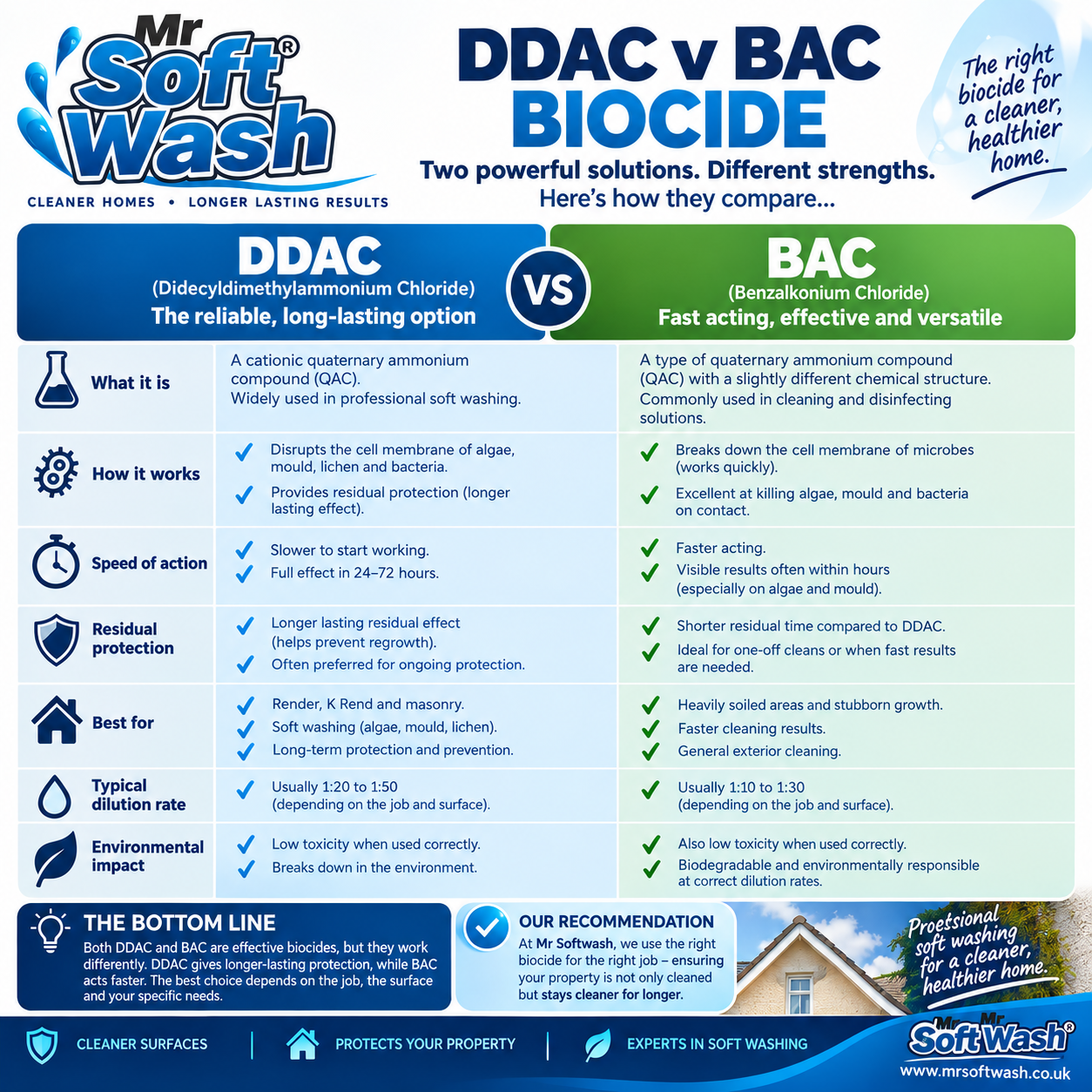
BAC vs DDAC
BAC and DDAC are different quaternary ammonium compounds.
Their suitability cannot be determined simply by comparing the active ingredient names.
Performance depends on the full formulation, authorised use, concentration, surface compatibility and treatment conditions.
Some products are intended for gradual biological treatment rather than immediate stain removal.
11.3 Specialist Render Cleaning Products
Several manufacturers produce cleaning products intended for rendered façades.
Some are formulated specifically for particular render systems.
Where the original render manufacturer offers an approved cleaning system, this is often a useful starting point.
Important Chemical Safety Considerations
Cleaning products should never be selected solely on the basis of their claimed strength.
Professional cleaning must consider:
Product instructions
Render compatibility
UK chemical and biocidal product requirements
Appropriate personal protective equipment
Safe handling and storage
Protection of nearby surfaces
Runoff containment
Environmental protection
Professional contractors should assess the risks and follow relevant safety requirements, including COSHH where applicable.
12. Can You Clean Silicone Render Yourself?
Light surface dirt may sometimes be removed by a homeowner using a manufacturer-approved cleaning method.
However, DIY cleaning becomes more complicated when dealing with biological contamination, chemical treatments or elevated areas.
DIY Cleaning Risks
Common problems include:
Using the wrong cleaning chemical
Applying excessive pressure
Damaging the surface texture
Producing uneven results
Incorrect chemical dilution
Chemical runoff
Damage to plants
Unsafe ladder use
Accidental chemical mixing
When to Use a Professional
Professional cleaning is particularly advisable when:
The building is more than one storey high
Large areas are contaminated
Black staining is extensive
The render is part of an EWI system
The coating is old or damaged
Previous cleaning has failed
Specialist access equipment is required
A professional should be able to explain the proposed cleaning method and demonstrate that it is appropriate for the surface.
13. How Often Should Silicone Render Be Cleaned?
There is no universal cleaning interval suitable for every property.
The frequency depends on environmental conditions, building design, render condition and the amount of biological contamination.
As a general maintenance planning guide:
Property Conditions
Suggested Inspection
Cleaning Approach
Exposed, sunny elevations
Annually
Clean when necessary
Typical residential properties
Annually
Clean based on contamination
Shaded or damp elevations
Every 6–12 months
Consider earlier treatment if growth develops
Properties surrounded by trees
Every 6–12 months
Monitor biological growth
Coastal properties
At least annually
Assess salt, dirt and biological deposits
Buildings with recurring algae
Every 6 months
Investigate moisture and recurring contamination
These are suggested inspection intervals, not manufacturer-prescribed cleaning schedules.
Many properties will not require professional cleaning every year.
The best approach is to clean silicone render when necessary rather than following an unnecessarily aggressive cleaning schedule.
14. How to Maintain Silicone Render
Preventative maintenance is essential for preserving the appearance and performance of silicone render.
14.1 Inspect the Render Regularly
Check exterior walls for:
Cracks
Discolouration
Algae growth
Water staining
Loose coatings
Damaged joints
Impact damage
Early identification can prevent minor issues from becoming more serious.
14.2 Keep Gutters Clear
Blocked or leaking gutters can repeatedly direct water onto rendered walls.
This encourages staining and may contribute to moisture-related defects.
Regular gutter maintenance is particularly important during autumn and winter.
14.3 Maintain Downpipes
Check that downpipes are securely fixed and functioning correctly.
Leaks can produce persistent damp streaks and encourage biological growth.
14.4 Manage Nearby Vegetation
Trees, shrubs and climbing plants can increase shading and restrict airflow.
Where appropriate, maintain sufficient clearance between vegetation and rendered walls.
14.5 Repair Cracks Promptly
Cracks may allow water to enter the render system.
Repairs should use materials compatible with the original system.
Avoid applying ordinary household filler or incompatible sealants to specialist render systems.
14.6 Check Window and Door Seals
Defective sealant around openings can allow water penetration.
Inspect joints periodically and arrange repairs where necessary.
14.7 Avoid Aggressive Cleaning
Do not use:
High-pressure jet washing without specific manufacturer approval
Wire brushes
Abrasive cleaning pads
Unapproved acid cleaners
Strong household degreasers
Unverified chemical mixtures
These methods can damage decorative coatings.
14.8 Arrange Periodic Professional Cleaning
Where biological contamination is recurring, professional cleaning can help maintain the appearance of the render.
The objective should be to remove contamination while preserving the original coating.
15. Does Silicone Render Need Repainting?
One of the advantages of through-coloured silicone render is that the decorative colour is incorporated into the coating.
This means routine painting is not normally required simply to provide its original colour.
However, silicone render can still experience:
Colour fading
Environmental staining
Uneven weathering
Previous repair marks
Surface damage
When might repainting be necessary?
Repainting may be considered when cleaning cannot restore an acceptable appearance or when the surface requires refurbishment.
Any coating applied over silicone render must be compatible with the existing system.
Using an inappropriate paint may reduce vapour permeability or affect moisture management.
Consult the original render manufacturer before applying a new coating.
16. How Long Does Silicone Render Last?
Silicone render is designed to provide a durable exterior finish.
However, its actual service life depends on several factors.
These include:
Product quality
Installation workmanship
Substrate preparation
Exposure to weather
Building movement
Maintenance
Moisture management
Physical damage
Some well-installed render systems can remain serviceable for several decades.
However, a specific lifespan should not be guaranteed without reference to the product, system specification and building conditions.
Can cleaning extend the life of silicone render?
Appropriate cleaning can help preserve appearance and reduce the accumulation of contaminants.
Regular inspection also helps identify defects before they worsen.
However, cleaning cannot correct structural movement, failed adhesion, trapped moisture or defective installation.
17. Common Silicone Render Problems
Problem 1: Silicone Render Turning Green
Possible cause: Algae growth encouraged by damp conditions.
Recommended action: Identify the contamination, investigate persistent moisture and use a suitable render-compatible treatment.
Problem 2: Black Stains on Render
Possible cause: Biological contamination, atmospheric pollution or a combination of contaminants.
Recommended action: Assess the staining before selecting a cleaning method.
Problem 3: Render Looking Patchy
Possible cause: Uneven weathering, biological contamination, inconsistent cleaning or variations in the original application.
Recommended action: Determine whether the issue is removable contamination or a coating defect.
Problem 4: Hairline Cracks
Possible cause: Building movement, thermal stress, substrate movement or installation-related issues.
Recommended action: Arrange an appropriate inspection and compatible repair.
Problem 5: White Staining
Possible cause: Salt deposits, mineral contamination, residues or moisture-related issues.
Recommended action: Identify the source before cleaning.
Problem 6: Render Peeling or Detaching
Possible cause: Adhesion failure, moisture problems, substrate defects or incompatible coatings.
Recommended action: Obtain a specialist render assessment.
Cleaning is not an appropriate substitute for repairing failed render.
Problem 7: Algae Returning After Cleaning
Possible cause: Persistent moisture, shading, nearby vegetation or incomplete treatment.
Recommended action: Review the cleaning method and address environmental factors where possible.
18. Silicone Render Maintenance in Coastal Areas
Coastal properties present particular maintenance challenges.
Buildings throughout Poole, Sandbanks, Bournemouth, Christchurch and the wider Dorset coastline may experience:
Wind-driven rain
Salt-laden air
High humidity
Strong coastal winds
Airborne sand and debris
Variable drying conditions
These factors can influence surface contamination and weathering.
Coastal Maintenance Recommendations
Inspect exposed elevations regularly, paying particular attention to joints, cracks and areas where water repeatedly runs down the wall.
Check metal fixings and adjacent components for corrosion.
Where salt deposits are present, identify the deposit and follow the render manufacturer's cleaning guidance.
Keep gutters and drainage systems functioning correctly.
Use professional cleaning when biological contamination becomes established.
Does Salt Air Damage Silicone Render?
Silicone render systems are often selected for their weather resistance, but coastal exposure can still affect a building.
The degree of resistance depends on the complete façade system, installation quality and maintenance.
Salt-related deterioration may also affect adjacent metal components, fixings and other building materials.
19. How Much Does Silicone Render Cleaning Cost?
The cost of professional silicone render cleaning depends on the individual property.
Important factors include:
Total surface area
Building height
Access requirements
Severity of contamination
Type of staining
Condition of the render
Cleaning method
Number of treatments required
Need for scaffolding or specialist access
Protection and runoff requirements
A small, easily accessible rendered wall will generally cost less to clean than a large multi-storey building with extensive contamination.
Why an Individual Quotation Matters
Two properties with similar surface areas may require very different cleaning approaches.
For example, light green algae on an accessible wall may be relatively straightforward to treat.
Heavy black staining on a high-level rendered façade may require additional investigation, access equipment and multiple cleaning stages.
Mr Softwash can assess the property and provide a quotation based on the work required.
20. Frequently Asked Questions About Silicone Render
Is Silicone Render Waterproof?
Silicone render is generally water-repellent rather than completely waterproof.
It is designed to reduce liquid water absorption while allowing a degree of vapour permeability.
The performance of the wall depends on the complete render system.
Does Silicone Render Get Algae?
Yes.
Silicone render can develop algae, particularly on damp, shaded or poorly ventilated elevations.
Water repellency does not prevent all biological growth.
Can You Soft Wash Silicone Render?
Yes, many silicone render systems can be cleaned using an appropriate soft washing method.
However, the cleaning products and techniques must be compatible with the specific render.
Can You Jet Wash Silicone Render?
Aggressive high-pressure jet washing is generally best avoided.
Some manufacturers permit controlled low-pressure rinsing, but this should not be confused with high-pressure cleaning.
What Causes Black Stains on Silicone Render?
Black staining can be caused by biological contamination, pollution, soot or other environmental deposits.
The exact cause should be identified before treatment.
Why Is My Silicone Render Turning Green?
Green discolouration is commonly associated with algae growth.
Moisture, shade and environmental conditions often contribute.
How Do You Remove Algae from Silicone Render?
Algae can often be treated using a compatible professional cleaning product.
The correct process depends on the render, level of contamination and product instructions.
Can Bleach Damage Silicone Render?
Yes.
Inappropriate bleach products, concentrations or application methods can damage coatings and surrounding materials.
Household bleach should not be assumed suitable for silicone render.
How Often Should Silicone Render Be Cleaned?
Cleaning frequency depends on environmental exposure and the condition of the surface.
Annual inspection is a sensible starting point, with cleaning arranged when necessary.
Does Silicone Render Need Painting?
Not normally as part of routine maintenance.
Many silicone renders are through-coloured.
Repainting may be appropriate for certain refurbishment projects, but only with a compatible coating system.
Can Silicone Render Be Repaired?
Yes, some localised damage can be repaired.
However, matching the original colour and texture can be difficult.
Repairs should follow the manufacturer's recommendations.
Does Silicone Render Fade?
Some colour change can occur over time due to sunlight, weathering and environmental exposure.
The degree of change depends on the product and conditions.
Is Silicone Render Better Than Acrylic Render?
Neither is universally better.
Silicone render is often chosen for its combination of water repellency and vapour permeability.
Acrylic render can also provide a durable, flexible finish.
The most suitable product depends on the building and system requirements.
Is K Rend the Same as Silicone Render?
Not exactly.
K Rend is a render brand offering several different products and systems.
Some K Rend products contain silicone technology, while others have different formulations.
It is important to identify the actual product rather than treating all K Rend finishes as identical.
Can You Clean Silicone Render on an Insulated Property?
Yes, in many cases.
However, the cleaning method must be suitable for the entire external wall insulation system.
Extra care is required around joints, cracks and damaged areas.
Can Cleaning Remove Every Stain?
No.
Biological growth and surface dirt can often be removed, but permanent discolouration, coating damage and some deeply embedded stains may remain.
A test patch can help establish realistic expectations.
21. Professional Silicone Render Cleaning in Poole, Bournemouth, Dorset and Hampshire
At Mr Softwash, we specialise in exterior cleaning services designed to remove biological contamination and restore the appearance of rendered properties.
Silicone render requires a careful approach because inappropriate cleaning can damage the decorative finish.
Our approach focuses on identifying the contamination, assessing the surface and selecting a suitable cleaning method.
Our Render Cleaning Services
We provide specialist cleaning for a range of rendered surfaces, including:
Silicone render
K Rend
Acrylic render
Mineral render
Monocouche render
External wall insulation finishes
Other compatible decorative render systems
All cleaning methods are subject to an assessment of the particular surface.
Areas We Cover
Mr Softwash provides exterior cleaning services across:
Poole: Including surrounding residential and coastal areas.
Bournemouth: Professional render cleaning for residential and commercial properties.
Christchurch: Render cleaning and biological contamination removal.
Dorset: Specialist exterior cleaning throughout the wider county.
Hampshire: Render cleaning services across suitable service areas.
Why Choose Professional Render Cleaning?
Correctly selected professional cleaning can help:
Improve the appearance of stained render
Remove suitable forms of biological contamination
Reduce the risk of cleaning-related damage
Maintain the building's appearance
Identify areas requiring repair or maintenance
The objective is not simply to make the render look cleaner.
It is to achieve an effective result while protecting the surface.
22. Silicone Render Maintenance Checklist
Use this checklist to help maintain your property's exterior.
Every 6 Months
Inspect shaded elevations for algae.
Check gutters and downpipes.
Look for water staining.
Check visible sealant joints.
Inspect areas around windows and doors.
Check for cracking or impact damage.
Annually
Inspect all accessible rendered elevations.
Review any recurring biological growth.
Check the condition of previous repairs.
Assess drainage and water runoff.
Consider whether professional cleaning is required.
After Severe Weather
Check for visible impact damage.
Inspect exposed joints and seals.
Look for displaced fixtures.
Check for unusual water staining.
Arrange an inspection if new cracks or defects appear.
When Biological Growth Appears
Identify the likely contamination.
Check for contributing moisture problems.
Avoid aggressive pressure washing.
Use a compatible cleaning treatment.
Seek professional advice for extensive contamination.
23. Final Thoughts: Keeping Silicone Render Clean and Protected
Silicone render is an attractive and durable exterior wall finish that offers important benefits for modern buildings.
Its water-repellent properties, vapour permeability and decorative appearance make it a popular choice throughout the UK.
However, even high-quality silicone render requires periodic inspection and maintenance.
Algae, black staining, atmospheric dirt and other contaminants can develop over time, particularly on shaded or moisture-exposed elevations.
The key to successful maintenance is understanding the type of render, identifying the cause of staining and choosing a cleaning method that will not damage the surface.
For many biologically contaminated silicone render surfaces, professional soft washing offers a suitable alternative to aggressive high-pressure cleaning.
Regular inspections, prompt repairs and appropriate cleaning can help preserve the appearance and condition of rendered buildings.
Need Professional Silicone Render Cleaning?
Mr Softwash – Specialist Silicone Render, K Rend and Exterior Cleaning
If your silicone render has become green, black, stained or discoloured, Mr Softwash can help assess the problem and recommend a suitable cleaning approach.
We provide professional render cleaning services throughout Poole, Bournemouth, Christchurch, Dorset and Hampshire.
Visit: www.mrsoftwash.co.uk
Contact Mr Softwash to discuss your silicone render cleaning requirements and request a quotation.
We need your consent to load the translations
We use a third-party service to translate the website content that may collect data about your activity. Please review the details in the privacy policy and accept the service to view the translations.