
Mr Softwash®
The Original Soft Washing Company
"The UK's K Rend & Render Cleaning Specialist"
Mr Softwash®
The Original Soft Washing Company
"The UK's K Rend & Render Cleaning Specialist"
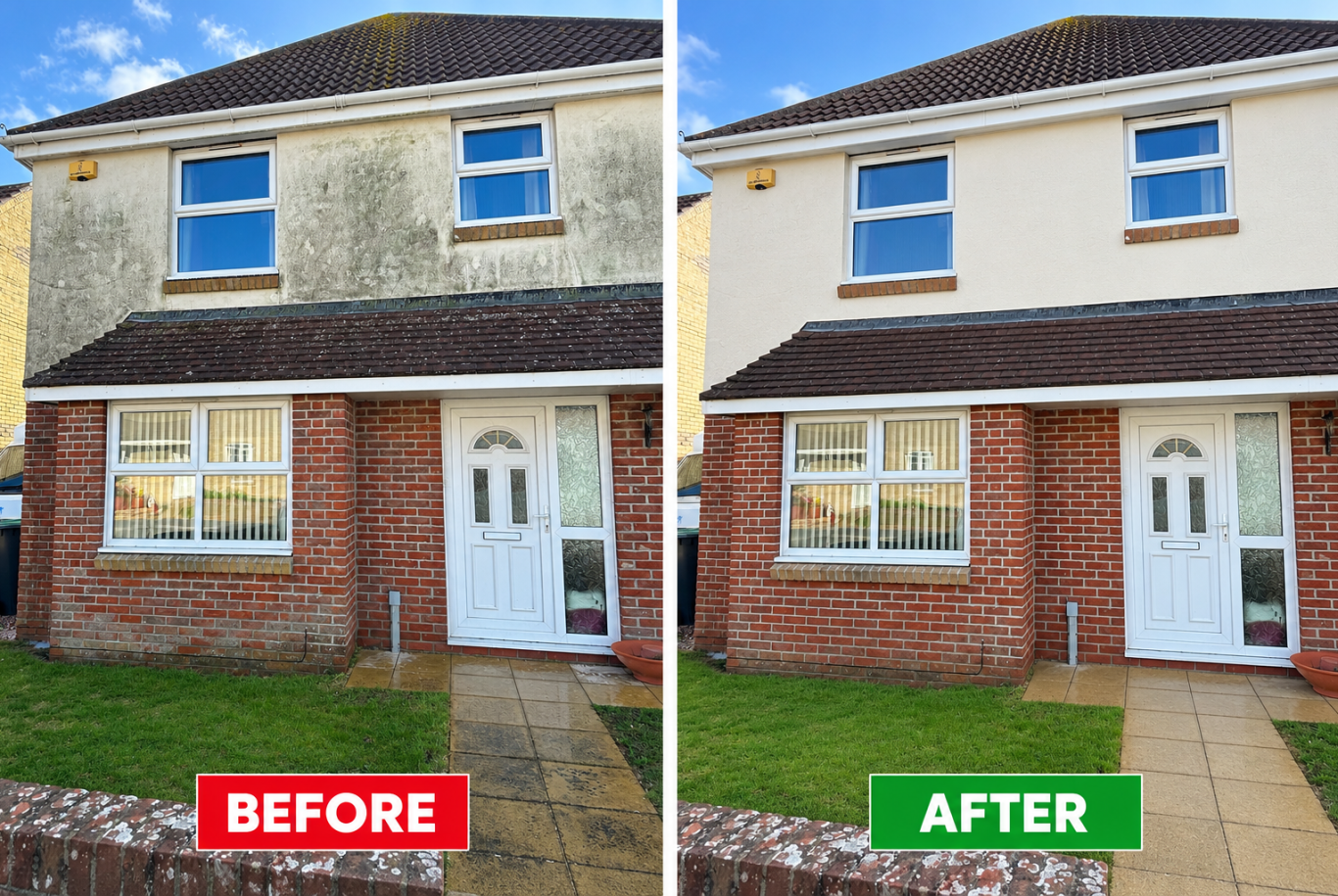
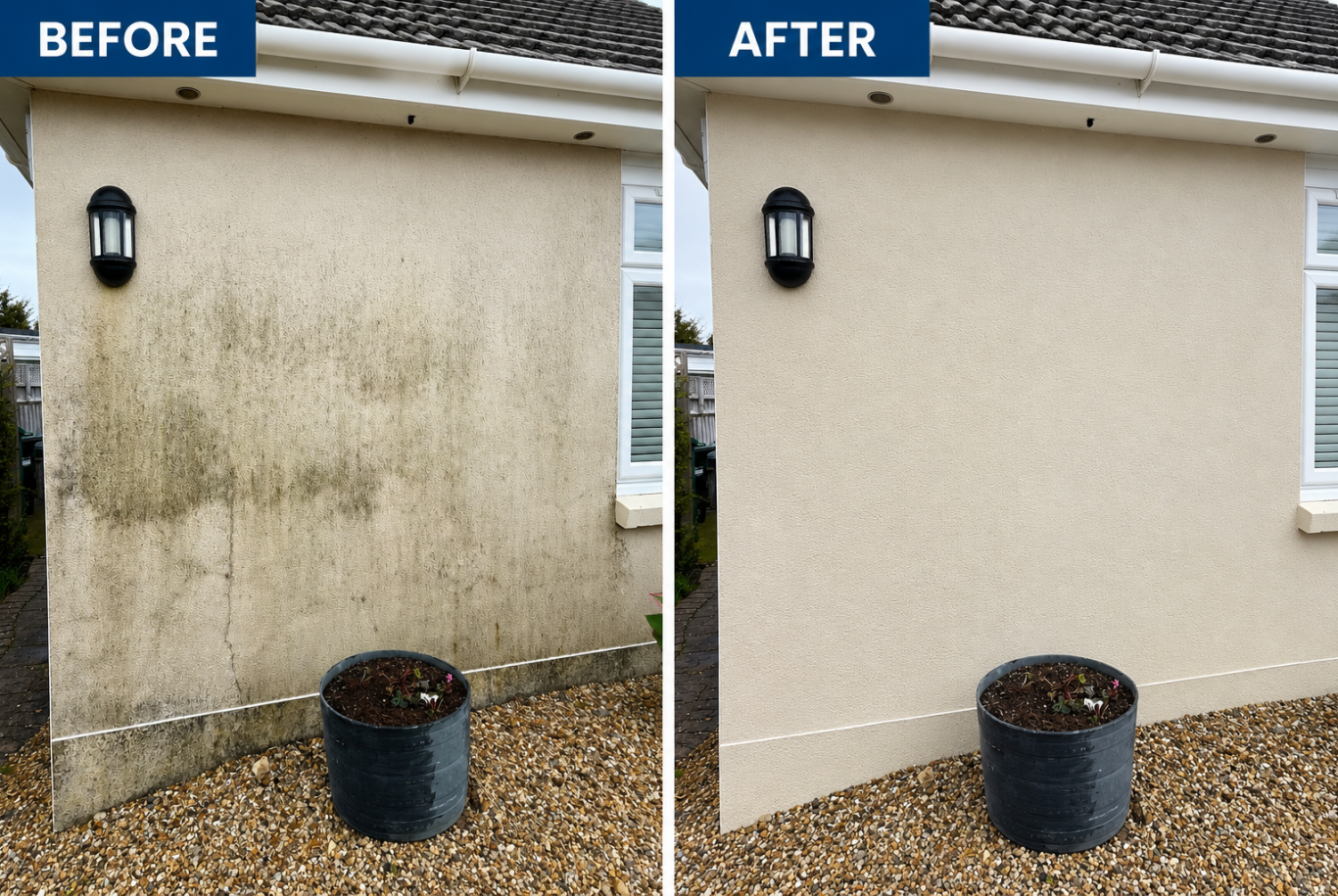
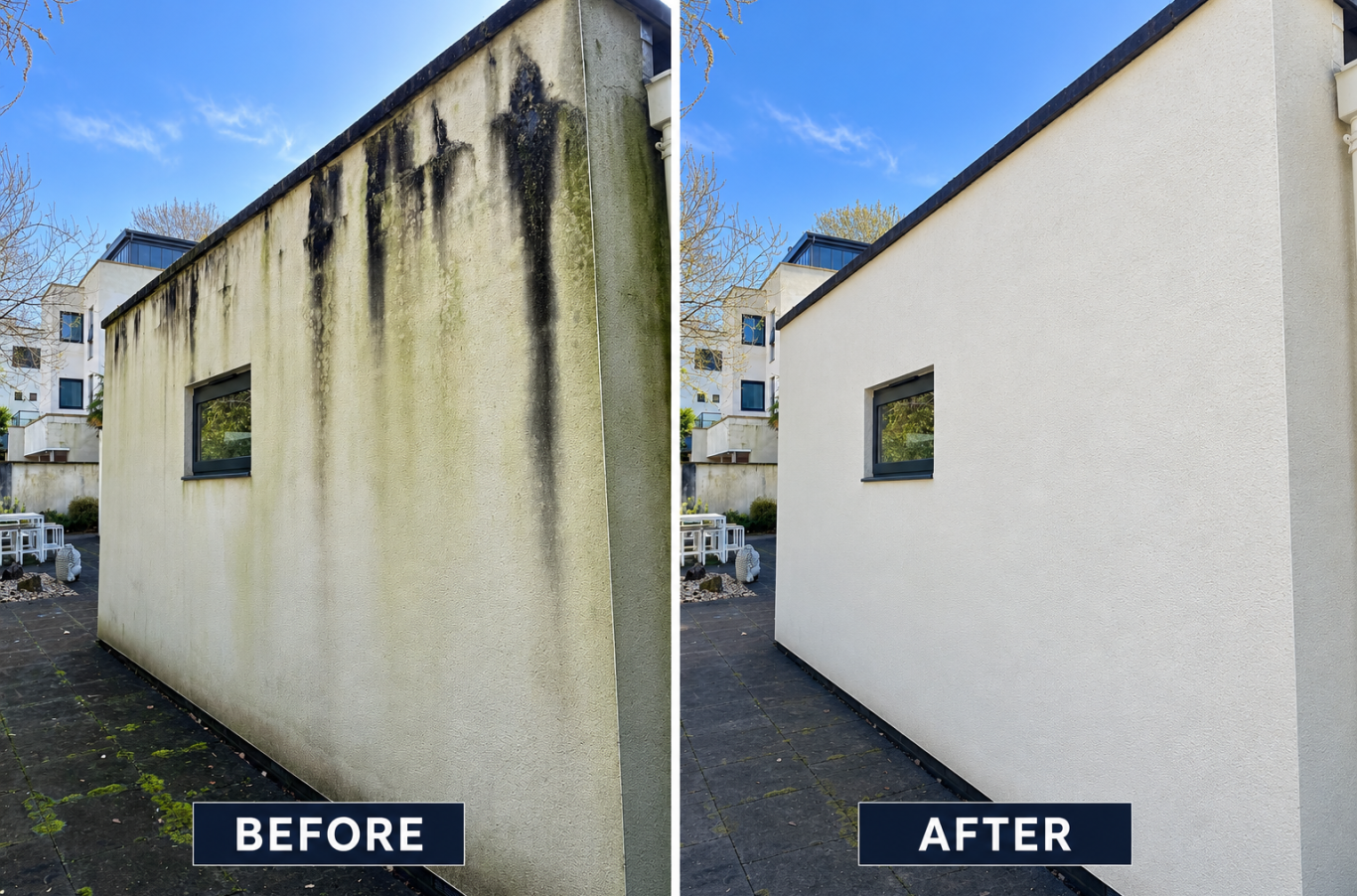
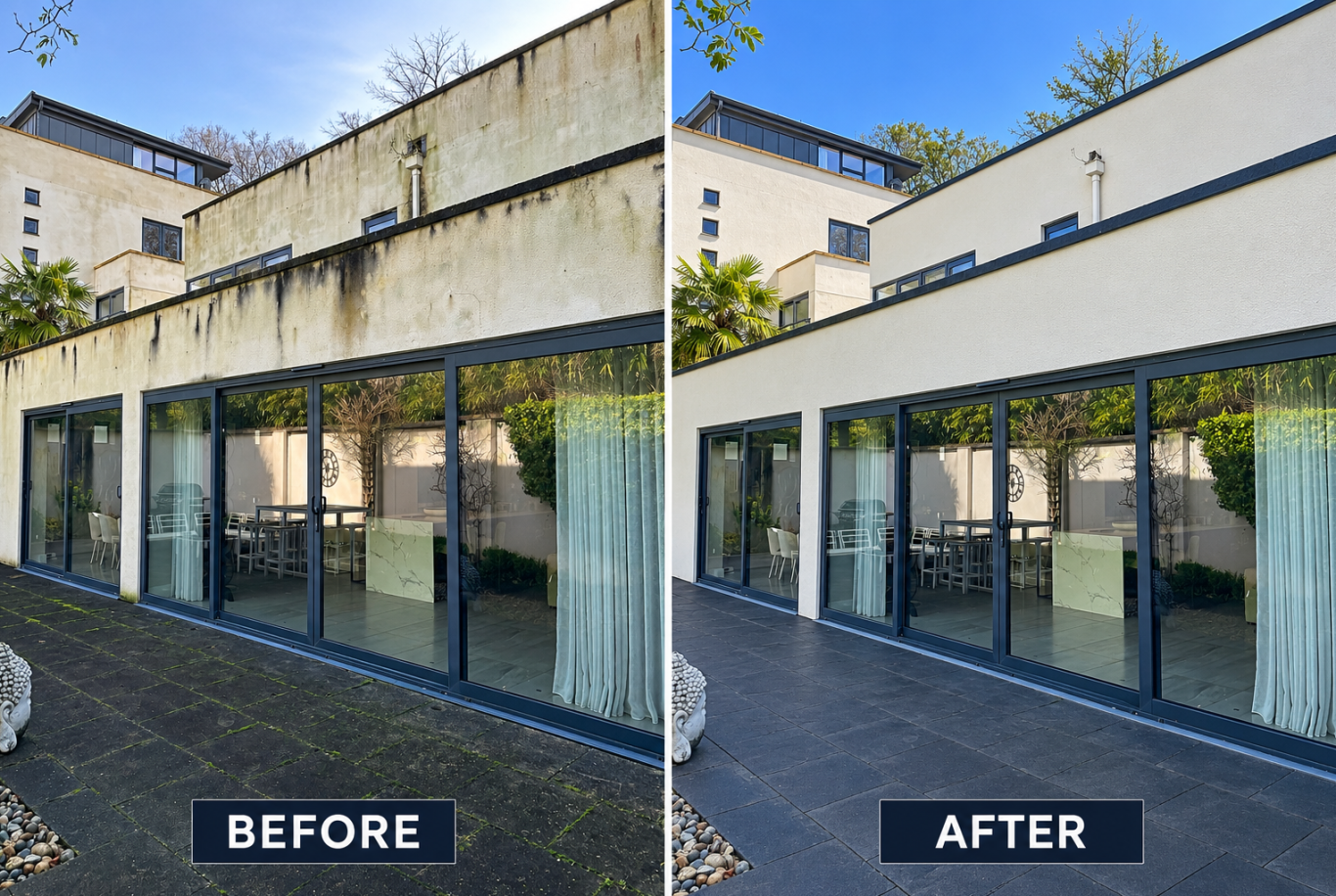
Removing Black Staining and Mould from Render – A Complete Guide
Professional Black Stain, Algae and Mould Removal from Render in Dorset & Hampshire
Black staining on exterior render is a common problem affecting residential and commercial properties throughout the UK. Over time, rendered walls can develop unsightly black streaks, dark patches, algae growth and mould-like discolouration that significantly affect the appearance of a building.
These stains are particularly noticeable on white and light-coloured render, including K Rend, silicone render, monocouche render and traditional rendered finishes.
At Mr Softwash, we specialise in professional render cleaning and the removal of black staining, algae, lichen and other biological contamination using carefully selected soft washing techniques.
We provide specialist render cleaning services throughout Poole, Bournemouth, Christchurch, Dorset and Hampshire, helping property owners restore the appearance of their rendered buildings without relying on aggressive high-pressure washing.
This complete guide explains what causes black staining on render, how to identify different types of contamination, the most effective cleaning methods and how to help prevent black stains from returning.
1. What Causes Black Staining on Render?
Black staining on render can develop for several reasons, and identifying the cause is essential before choosing a cleaning method.
Although many homeowners describe dark staining as black mould, not all black marks are caused by mould.
Common causes include:
Black algae and other biological growth
Fungal contamination
Cyanobacteria and other microorganisms
Atmospheric pollution and traffic deposits
Dirt and organic debris
Water runoff and moisture retention
Lichen growth
Carbon-based deposits and soot
In many cases, several forms of contamination are present simultaneously.
The porous or textured nature of certain render finishes can allow moisture and dirt to accumulate, creating conditions that encourage biological growth.
Black Algae on Render
Black algae is a term commonly used to describe dark biological staining on rendered walls.
The appearance can range from small black spots to extensive dark patches covering large sections of a building.
Some dark staining attributed to algae may actually involve cyanobacteria, fungi or mixed microbial communities.
These organisms can colonise exterior surfaces where moisture, shade and environmental conditions are favourable.
Black biological staining commonly appears:
On north-facing walls
Beneath rooflines and window sills
Around guttering and downpipes
On shaded elevations
In areas exposed to persistent dampness
On walls surrounded by trees and vegetation
Unlike ordinary surface dirt, biological staining may not be effectively removed through water rinsing alone.
A suitable specialist cleaning treatment is often required.
2. Is Black Staining on Render Mould?
One of the most common questions homeowners ask is:
Is the black staining on my render actually mould?
The answer depends on the type of contamination.
Black staining may be caused by mould or other fungi, but dark algae, cyanobacteria, lichen and atmospheric deposits can produce similar appearances.
Visual inspection alone cannot always identify the exact organism responsible.
Black Mould
Exterior mould is a type of fungal growth that can develop on damp surfaces.
It may appear as dark spots, irregular patches or extensive discolouration.
Black Algae
Black algae is a general description for dark biological growth that develops on external surfaces.
It is often associated with moisture, shade and prolonged exposure to damp conditions.
Black Lichen
Lichen consists of a fungus living in association with an alga or cyanobacterium.
Some lichens produce dark, firmly attached growths that can be particularly difficult to remove.
Pollution Staining
Black staining may also result from airborne pollutants, soot and other environmental deposits.
These stains are not necessarily biological and may require a different cleaning approach.
Mr Softwash assesses the likely cause of staining before selecting an appropriate render cleaning treatment.
3. Why Does Render Develop Black Stains?
Several environmental factors contribute to the development of black staining on rendered buildings.
Moisture and Damp Conditions
Moisture is one of the main factors encouraging biological contamination.
Rendered walls exposed to frequent rainfall, condensation or persistent dampness can provide suitable conditions for microorganisms to grow.
North-Facing Walls
North-facing elevations generally receive less direct sunlight.
As a result, these walls may remain damp for longer periods, encouraging algae and fungal growth.
Trees and Vegetation
Properties surrounded by trees, hedges and dense vegetation may experience increased shade and reduced airflow.
Organic debris can also accumulate on rendered surfaces.
Blocked or Leaking Gutters
Faulty guttering and downpipes can direct excess water onto rendered walls.
This may produce distinctive vertical staining patterns beneath the source of the water.
Coastal Environments
Properties throughout Poole, Bournemouth, Christchurch and coastal Dorset experience environmental conditions that can contribute to surface contamination.
Coastal humidity, wind-driven rain and exposure to airborne deposits can influence how quickly rendered surfaces become dirty.
Render Texture
Textured render can retain dirt and moisture within small surface irregularities.
This can make contamination more difficult to remove than on smooth, non-porous materials.
4. How to Remove Black Staining from Render
The most suitable method depends on the render type, condition and cause of staining.
For biological contamination, professional soft washing is often an effective approach.
Unlike aggressive pressure washing, soft washing uses controlled low-pressure application and appropriate cleaning treatments to target organic contamination.
Step 1 – Inspect the Render
Before cleaning, the rendered surface should be assessed for:
Cracks and damaged areas
Loose or detached render
Existing discolouration
Signs of water penetration
Surface coatings
Type and extent of biological contamination
This inspection helps determine whether cleaning is suitable and which methods should be used.
Step 2 – Identify the Render Type
Different render systems require different cleaning considerations.
Common render types include:
K Rend: A popular through-coloured render system that requires cleaning methods compatible with its particular finish.
Silicone render: A modern render system with water-repellent properties, although it can still develop biological contamination.
Monocouche render: A through-coloured render that may be vulnerable to damage from inappropriate cleaning methods.
Acrylic render: A polymer-based render finish that requires consideration of its coating and chemical compatibility.
Traditional cement render: A mineral render that can vary considerably in strength, porosity and condition.
The cleaning method should always follow the relevant manufacturer's guidance.
Step 3 – Apply a Suitable Soft Washing Treatment
Where biological staining is present, a suitable biocidal or specialist render cleaning treatment may be used.
The product must be appropriate for the render system and the contamination being treated.
Depending on the treatment, it may help control or remove algae, fungal growth and other microorganisms.
Professional application allows the treatment to be distributed across the affected surface while minimising unnecessary mechanical force.
Step 4 – Allow the Treatment to Work
The treatment must be given the appropriate contact time in accordance with its product instructions.
Some biological stains respond relatively quickly, while more established contamination may require additional treatment or a longer period before the full visual improvement becomes apparent.
Step 5 – Rinse Where Required
Some render cleaning systems require controlled low-pressure rinsing.
Other treatments are designed to remain on the surface and work progressively.
The correct procedure depends on the product, the render manufacturer's recommendations and the condition of the wall.
Step 6 – Assess the Results
Following treatment, the render is inspected to determine whether further cleaning is necessary.
Persistent staining may require additional attention, particularly where contamination has become deeply established or where non-biological deposits remain.
5. Can You Pressure Wash Black Stains Off Render?
Pressure washing may remove some surface contamination, but high-pressure cleaning can damage certain rendered finishes.
Potential problems include:
Surface erosion
Loss of render texture
Damage to protective coatings
Water penetration through cracks
Uneven cleaning marks
Dislodging weakened render
Increased surface roughness
Some render manufacturers permit carefully controlled pressure cleaning under specific conditions.
However, the pressure, equipment, cleaning distance and technique must be suitable for the render system.
At Mr Softwash, we favour low-pressure cleaning methods where appropriate because they allow biological contamination to be treated without relying on excessive mechanical force.
For many rendered properties, specialist soft washing is a more suitable option than aggressive pressure washing.
6. Removing Black Stains from K Rend
K Rend is widely used on modern residential and commercial properties throughout Dorset and Hampshire.
Although many K Rend products are designed to provide durable, attractive exterior finishes, they can still develop black staining and biological growth.
Dark contamination is especially noticeable on white, cream and light-coloured K Rend.
Why Does K Rend Turn Black?
K Rend can develop dark staining because of:
Algae and other microorganisms
Fungal growth
Moisture retention
Shaded conditions
Atmospheric pollution
Water runoff
Environmental contamination
The appearance of staining can vary depending on the particular render product and local conditions.
How Do You Clean Black Stains from K Rend?
The most appropriate method depends on the K Rend system and the nature of the staining.
Where biological contamination is responsible, an approved and compatible render cleaning treatment may be effective.
Cleaning should follow K Rend's guidance for the specific product.
Mr Softwash uses a surface-led approach to K Rend cleaning, assessing the condition of the render and selecting an appropriate cleaning process.
Can Black Stains Be Completely Removed from K Rend?
Many forms of biological black staining can be substantially reduced or removed with suitable professional treatment.
However, results depend on factors including:
Age of the contamination
Type of biological growth
Render condition
Previous cleaning methods
Surface porosity
Presence of permanent discolouration
Some surfaces may retain residual marks even after the biological contamination has been treated.
Professional assessment is recommended where staining is particularly extensive.
7. Removing Black Mould from Silicone Render
Silicone render is commonly used on modern properties because of its water-repellent characteristics and decorative appearance.
However, silicone render is not completely immune to biological growth.
Over time, black staining may develop on shaded or persistently damp elevations.
Why Does Silicone Render Develop Black Staining?
Possible contributing factors include:
Persistent moisture
Limited sunlight
Environmental contamination
Organic deposits
Biological colonisation
Poor drainage or water runoff
Although silicone render can resist water absorption, microorganisms may still grow on dirt and moisture present on the surface.
How Is Silicone Render Cleaned?
Silicone render should be cleaned using products and methods compatible with the specific system.
An appropriate low-pressure treatment may remove biological contamination while helping protect the decorative finish.
Harsh cleaning chemicals, abrasive methods and unsuitable pressure washing should be avoided.
Mr Softwash provides specialist silicone render cleaning throughout Dorset and Hampshire.
8. What Chemicals Remove Black Staining from Render?
Different cleaning chemicals are used to treat biological contamination on exterior surfaces.
The correct product depends on the type of staining, render compatibility, environmental conditions and manufacturer's instructions.
Sodium Hypochlorite
Sodium hypochlorite is an oxidising chemical used in some professional exterior cleaning applications.
When used in an appropriately formulated and controlled cleaning process, it can help remove certain forms of biological staining.
However, sodium hypochlorite is not suitable for every render system.
Incorrect use can cause discolouration, damage surrounding materials and create risks to people, plants and the environment.
It should never be mixed with acids, ammonia or incompatible cleaning products.
Benzalkonium Chloride (BAC)
Benzalkonium chloride is a quaternary ammonium compound used as an active ingredient in certain biocidal formulations.
Depending on the product's authorisation and intended use, it may be suitable for controlling microorganisms associated with exterior surface contamination.
Didecyldimethylammonium Chloride (DDAC)
DDAC is another quaternary ammonium compound used in some biocidal products.
It may be included in specialist treatments intended to control biological growth on external surfaces.
Specialist Render Cleaning Products
Some render manufacturers recommend specific cleaning products or maintenance systems.
These should generally be considered before selecting an alternative treatment.
Important Safety Considerations
Professional render cleaning products must be used according to their labels, safety information and applicable UK regulations.
Where biocides are used, the product must be legally permitted for the intended application.
Cleaning operations should also include suitable precautions to protect:
People and pets
Plants and landscaping
Adjacent materials
Watercourses
Surface water drains
Surrounding property
At Mr Softwash, the selection of cleaning products is based on the surface, contamination and requirements of the particular job.
9. Can You Remove Black Stains from Render Yourself?
Minor surface contamination may sometimes be cleaned by a homeowner using an appropriate product approved for the render.
However, there are important considerations.
Using an unsuitable cleaning product can damage the finish or cause permanent discolouration.
Aggressive brushing may also alter the surface texture.
High-pressure washing can create additional risks, especially on older or damaged render.
Working at height presents further safety concerns.
For extensive black staining, delicate render finishes or difficult-to-access elevations, professional render cleaning is generally the more appropriate option.
A specialist can assess the render and select a cleaning process suitable for the surface.
10. How Long Does It Take to Remove Black Staining from Render?
The time required depends on several factors.
These include:
Size of the affected area
Severity of contamination
Render type
Accessibility
Cleaning product
Weather conditions
Whether additional treatments are required
Some stains can be visibly reduced during the cleaning process.
Other biological contamination may take longer to break down or weather away following treatment.
In certain cases, further cleaning may be necessary.
It is important to distinguish between killing or controlling microorganisms and removing all visible staining.
A successful biological treatment does not always produce an immediate, completely stain-free appearance.
11. Will Black Staining Return After Render Cleaning?
Biological contamination can return because exterior render remains exposed to the environment.
Spores, microorganisms and airborne deposits are continually present outdoors.
The speed at which staining returns depends on factors such as:
Sunlight exposure
Moisture levels
Local vegetation
Air circulation
Building orientation
Surface condition
Local environmental conditions
No exterior render cleaning treatment can guarantee that biological growth will never return.
However, appropriate cleaning and maintenance can help keep rendered surfaces looking cleaner for longer.
12. How to Prevent Black Staining on Render
Although it is not always possible to prevent biological contamination completely, several maintenance measures can reduce the conditions that encourage its development.
Maintain Gutters and Downpipes
Ensure gutters remain clear and that downpipes direct rainwater away from rendered walls.
Repair leaking joints and overflowing guttering promptly.
Improve Air Circulation
Where practical, trim vegetation that grows directly against rendered surfaces.
Improved airflow can help damp walls dry more quickly.
Reduce Persistent Moisture
Investigate sources of excessive moisture, including leaking pipes, defective roof drainage and damaged building details.
Inspect Render Regularly
Check exterior walls for early signs of algae, mould-like staining and surface deterioration.
Early attention may prevent contamination from becoming extensive.
Arrange Periodic Professional Cleaning
A suitable maintenance programme can help manage recurring biological growth.
The appropriate cleaning frequency will depend on the property, exposure and render system.
Follow Manufacturer Maintenance Guidance
Different render systems have different cleaning and maintenance requirements.
Always follow the manufacturer's recommendations, particularly where a render system remains under warranty.
13. Black Staining vs Green Algae on Render
Black and green staining are common forms of exterior biological contamination.
Although they may occur together, their appearance and behaviour can differ.
Green Algae
Green algae typically produces green surface discolouration.
It often develops in damp, shaded locations and may spread across large areas of render.
Black Biological Staining
Black staining can involve dark algae, cyanobacteria, fungi or mixed biological growth.
Some dark contamination can be particularly persistent.
Which Is Harder to Remove?
The difficulty depends on the specific organisms, the render type and how firmly the contamination is attached.
Certain dark stains can be more resistant to cleaning than light green surface growth.
Both types should be treated using methods suitable for the particular render system.
14. How Much Does Black Stain Removal from Render Cost?
The cost of removing black staining from render varies depending on the property and the work required.
Factors affecting the price include:
Property size: Larger rendered elevations generally require more cleaning time and materials.
Severity of staining: Heavily contaminated walls may require additional treatment.
Render type: Some finishes require more specialised cleaning methods.
Access requirements: Difficult-to-reach areas may require specialist access equipment.
Building height: Multi-storey properties can involve additional access and safety considerations.
Surface condition: Damaged or deteriorating render may require repairs before cleaning.
At Mr Softwash, we provide quotations based on the individual property and its cleaning requirements.
For an accurate quotation, contact us with details of your property and photographs of the affected render.
15. Professional Black Stain Removal in Poole, Bournemouth, Christchurch, Dorset & Hampshire
Mr Softwash provides professional exterior render cleaning services for residential and commercial properties.
Our services include the assessment and treatment of:
Black staining on render
Black algae and biological contamination
Exterior mould and fungal growth
Green algae on render
Red and pink biological staining
Lichen contamination
K Rend discolouration
Silicone render contamination
General exterior render staining
We work with a range of rendered surfaces, selecting cleaning methods appropriate for the material and its condition.
Black Stain Removal in Poole
Properties throughout Poole can develop biological staining because of moisture, shade and environmental exposure.
Mr Softwash provides specialist render cleaning services to help restore the appearance of affected exterior walls.
Black Stain Removal in Bournemouth
Rendered properties in Bournemouth may experience algae growth, black staining and other forms of exterior contamination.
Our render cleaning services are designed to address biological staining using suitable professional cleaning methods.
Black Stain Removal in Christchurch
We provide render cleaning services in Christchurch, helping homeowners and property managers address unsightly dark staining and biological growth.
Black Stain Removal Across Dorset
Mr Softwash provides render cleaning services across Dorset, including properties affected by persistent algae, fungal growth and other environmental contamination.
Black Stain Removal in Hampshire
We also provide specialist render cleaning services in Hampshire, including the cleaning of K Rend, silicone render and other compatible rendered finishes.
16. Why Choose Mr Softwash for Black Stain Removal?
Choosing the correct cleaning method is essential when dealing with delicate rendered surfaces.
At Mr Softwash, we focus on identifying the type of surface and the likely cause of contamination before selecting an appropriate treatment.
Specialist Render Cleaning
We focus on exterior cleaning methods suited to rendered buildings and other sensitive surfaces.
Low-Pressure Cleaning Techniques
Where appropriate, we use soft washing methods to reduce reliance on aggressive pressure washing.
Surface-Specific Treatments
Different render systems require different cleaning considerations.
We assess the surface before selecting a treatment.
Biological Contamination Removal
Our cleaning approach addresses algae, mould-like growth and other biological contamination that can affect the appearance of exterior render.
Local Service
We provide professional render cleaning services throughout Poole, Bournemouth, Christchurch, Dorset and Hampshire.
17. Frequently Asked Questions About Black Staining on Render
What is the black stuff growing on my render?
Black staining may be caused by algae, cyanobacteria, fungi, lichen or environmental pollution.
Several types of contamination may be present simultaneously.
A professional assessment can help identify the most likely cause and suitable cleaning method.
Can black mould be removed from exterior render?
Yes. Many forms of exterior fungal contamination can be treated and removed using appropriate cleaning methods.
However, the results depend on the render condition and the nature of the staining.
What is the best way to remove black algae from render?
A suitable specialist render cleaning treatment, often applied using low-pressure soft washing techniques, can be effective.
The product and method must be compatible with the render system.
Can you remove black stains from K Rend?
Yes. Many biological stains on K Rend can be substantially reduced or removed using appropriate cleaning treatments.
The manufacturer's recommendations should be followed to avoid damaging the finish.
Does bleach remove black stains from render?
Sodium hypochlorite-based products can remove certain types of biological staining.
However, household bleach should not automatically be considered suitable for render.
Inappropriate products or concentrations can damage surfaces and surrounding materials.
A specialist render cleaning product compatible with the particular finish is preferable.
Will pressure washing damage my render?
Excessive pressure can damage certain rendered finishes.
Some systems allow controlled pressure cleaning, but the correct method depends on the render manufacturer's guidance and the condition of the surface.
Why does my white render keep turning black?
Recurring black staining is often associated with moisture, shade, biological growth or pollution.
North-facing walls and areas beneath leaking gutters can be particularly vulnerable.
Can black staining permanently damage render?
Some biological contamination can contribute to surface deterioration, particularly where moisture and existing defects are present.
However, staining alone does not necessarily mean the render has suffered structural damage.
A professional inspection can help identify whether repairs are needed.
How often should rendered walls be cleaned?
There is no universal cleaning interval.
Properties exposed to persistent moisture and shade may require more frequent maintenance than those in sunny, well-ventilated locations.
Regular inspections can help determine when cleaning is necessary.
Does soft washing prevent black algae from returning?
Soft washing can remove or control existing biological contamination.
However, it cannot permanently prevent recolonisation.
Ongoing maintenance and addressing moisture problems can help reduce recurrence.
Can black stains be removed without repainting render?
In many cases, yes.
Where staining is caused by biological contamination, specialist cleaning may restore the appearance of the render without repainting.
However, permanent discolouration or damaged coatings may require additional work.
Can black staining be removed from coloured render?
Many forms of biological staining can be treated on coloured render.
Care is essential because unsuitable cleaning products can affect pigments, coatings or the surface finish.
18. Get a Free Quote for Black Stain and Mould Removal from Render
Restore the Appearance of Your Render with Mr Softwash
Black staining, algae and mould-like contamination can make an otherwise attractive property appear dirty and poorly maintained.
Fortunately, many forms of biological staining can be treated using professional render cleaning techniques.
At Mr Softwash, we provide specialist cleaning services for K Rend, silicone render, monocouche render and other compatible exterior finishes.
Whether your property has developed black streaks, dark patches, algae growth or extensive biological contamination, we can assess the surface and recommend a suitable cleaning approach.
Our service areas include Poole, Bournemouth, Christchurch, Dorset and Hampshire.
Contact Mr Softwash Today
For professional black stain removal, mould treatment and exterior render cleaning, contact Mr Softwash for a free, no-obligation quotation.
Visit www.mrsoftwash.co.uk to learn more about our specialist render cleaning services.
Mr Softwash – Professional Render Cleaning, Soft Washing and Exterior Surface Cleaning in Dorset & Hampshire.
Give me a quick call or send me an email
Written Quote
Tell me what you need and I'll send you a free written quote to your phone or by email
We need your consent to load the translations
We use a third-party service to translate the website content that may collect data about your activity. Please review the details in the privacy policy and accept the service to view the translations.