
Mr Softwash®Miracle Wash
"Voted Soft Washing Company of the year 2024/25 & 25/26"
Mr Softwash®Miracle Wash
"Voted Soft Washing Company of the year 2024/25 & 25/26"

How To Clean K-Rend Professionally Without Causing Damage
K-Rend has become one of the UK’s most popular render systems thanks to its attractive appearance, low maintenance requirements and wide range of colours. However, like any external building finish, it is exposed to the elements every day and will eventually develop staining from algae, mould, pollution and general dirt.
Cleaning K-Rend requires far more care than simply pressure washing the surface. Using the wrong equipment or chemicals can permanently damage the textured finish, leaving costly repairs that could have been avoided.
We specialise in professional render cleaning using methods designed to restore K-Rend safely while protecting its appearance for years to come.
What Is K-Rend?
K-Rend is a silicone-based coloured render system designed to provide an attractive, weather-resistant finish without requiring regular painting.
Its benefits include:
Although K-Rend is designed to resist dirt better than traditional renders, it is not completely maintenance-free.
Why Does K-Rend Become Dirty?
Over time, airborne contaminants begin settling onto the surface.
These include:
Properties located near trees, woodland or water often experience contamination more quickly due to increased moisture and airborne spores.
North-facing walls usually become dirty first because they receive less direct sunlight, allowing biological growth to thrive.
Common Causes Of K-Rend Staining
Cause
Appearance
Common Location
Green algae
Green streaks
Shaded walls
Red algae
Pink or red staining
Damp elevations
Black mould
Black spotting
Around windows
Traffic pollution
Grey film
Roadsides
Lichen
White or yellow patches
Older render
Organic dirt
Brown staining
Beneath trees
Why Pressure Washing Can Damage K-Rend
One of the biggest mistakes homeowners make is hiring someone who relies on high-pressure washing.
While pressure washers may produce instant visual improvements, they can also cause irreversible damage.
Potential problems include:
The textured silicone finish is designed to shed water naturally. Excessive pressure may compromise this protective layer.
Professional render cleaning focuses on chemistry rather than force.
The Professional Softwashing Approach
Softwashing has become the preferred cleaning method for K-Rend throughout the UK.
Instead of relying on pressure, carefully selected cleaning solutions break down biological contamination before it is gently removed.
This approach provides several advantages:
The cleaning solution does the work rather than excessive water pressure.
Comparing Cleaning Methods
Safe for K-Rend
Removes Algae
Risk of Damage
High-pressure washing
❌
Temporary
High
Medium-pressure washing
⚠️
Moderate
Medium
Softwashing
✅
Excellent
Very Low
Hand scrubbing
✅
Good
Low
Steam cleaning
Sometimes
Good
Low when correctly controlled
Step One: Inspect The Render
Every professional clean begins with a detailed inspection.
The technician assesses:
No two K-Rend properties weather in exactly the same way.
An inspection allows the correct treatment plan to be developed before cleaning begins.
Step Two: Protect Surrounding Areas
Professional preparation is essential.
Nearby areas requiring protection include:
Protecting the surrounding property is just as important as cleaning the render itself.
Step Three: Apply Specialist Cleaning Chemicals
Professional render cleaning solutions are designed specifically for biological contamination.
Depending on the property, treatment may target:
The chemicals are carefully diluted according to:
Allowing sufficient dwell time enables the solution to penetrate and destroy algae spores beneath the surface.
Why Dwell Time Matters
Many cleaning failures occur because chemicals are rinsed away too quickly.
Professional cleaners allow enough time for the treatment to:
This reduces the likelihood of rapid regrowth.
Step Four: Gentle Rinsing
Once the chemical has completed its work, the surface is rinsed carefully.
Unlike traditional pressure washing, rinsing uses controlled water flow designed to remove contamination without damaging the render.
The emphasis remains on preserving the original finish rather than blasting dirt away.
Which Chemicals Are Used?
Different contamination requires different treatments.
Common professional products include:
Chemical Type
Primary Purpose
Professional biocide
Kill algae and mould
Softwash solution
Remove organic growth
Render detergent
Remove atmospheric dirt
Specialist surfactants
Improve coverage
Residual biocide
Reduce regrowth
Household bleach and general-purpose exterior cleaners rarely provide the same long-term performance as professional products.
Removing Green Algae
Green algae is by far the most common issue affecting K-Rend.
It usually appears as:
Professional biocides destroy the algae while helping prevent spores from quickly returning.
Simply washing away the visible growth rarely solves the underlying problem.
Treating Red Algae
Red algae has become increasingly common on newer render systems.
Unlike green algae, it often penetrates deeper into microscopic pores.
Removal frequently requires:
Patience is essential, as aggressive cleaning may permanently affect the finish.
Dealing With Black Mould
Black mould often develops around:
Professional mould treatments attack the biological growth at its source rather than merely removing the visible staining.
Areas That Usually Need Extra Attention
Area
Reason
North-facing walls
Less sunlight
Beneath gutters
Moisture retention
Around windows
Condensation
Under roof edges
Limited drying
Behind shrubs
Reduced airflow
These areas often require slightly longer treatment times.
Can K-Rend Be Steam Cleaned?
Steam cleaning can sometimes be suitable for K-Rend, but only under carefully controlled conditions.
When performed professionally, low-pressure steam may help remove:
However, steam alone does not normally provide long-term protection against algae.
For this reason, it is often combined with professional biocide treatments.
How Often Should K-Rend Be Cleaned?
There is no fixed schedule.
Frequency depends on:
Typical maintenance intervals are:
Environment
Suggested Inspection
Urban
Every 3–4 years
Rural
Every 2–3 years
Woodland
Every 2 years
Coastal
Every 2–3 years
Regular inspections help identify early staining before heavier contamination develops.
Common DIY Mistakes
Attempting to clean K-Rend without specialist knowledge often leads to disappointing results.
Frequent mistakes include:
Even well-intentioned DIY cleaning can shorten the life of the render.
Why Professional Equipment Matters
Professional render cleaning equipment differs significantly from domestic pressure washers.
Specialist systems offer:
Using the correct equipment reduces the likelihood of accidental damage while producing a more uniform finish.
Weather Conditions Influence Cleaning Results
Professional contractors carefully monitor weather forecasts before starting work.
Ideal conditions generally include:
Very hot weather can cause chemicals to dry too quickly, while heavy rain may dilute treatments before they have finished working.
Planning around suitable weather helps maximise cleaning performance.
Why Long-Term Prevention Is Better Than Frequent Cleaning
Although K-Rend is designed as a low-maintenance finish, allowing heavy contamination to build up makes future cleaning more difficult.
Regular professional maintenance offers several benefits:
Addressing algae and mould early usually requires less intensive treatment than waiting until the render is heavily affected.
Choosing A Professional K-Rend Cleaning Service
Not all exterior cleaning companies have experience working with silicone render systems. K-Rend requires an understanding of both the surface material and the cleaning products used to treat it safely.
Every K-Rend cleaning project begins with a detailed assessment to identify the type of contamination, the condition of the render and the most suitable cleaning method. Rather than relying on high pressure, we use carefully selected softwashing treatments and controlled cleaning techniques designed to restore the render while preserving its textured finish.
Premium K-Rend cleaning is an investment in protecting your property’s exterior. While professional treatments are typically positioned at the higher end of the market due to the specialist chemicals, equipment and expertise involved, they help minimise the risk of damage and deliver results that last significantly longer than many DIY or low-cost cleaning methods.
Understanding Different Types Of K-Rend Finishes
Although many people refer to all silicone render as “K-Rend”, there are actually several different finishes available, each with slightly different cleaning requirements.
Some finishes have a smoother texture, while others have a more pronounced grain that can trap dirt and biological growth more easily.
Common finishes include:
Finish Type
Surface Texture
Cleaning Difficulty
Fine texture
Smooth
Easy
Medium texture
Slight grain
Moderate
Scraped finish
Textured
Moderate
Rough texture
Coarser finish
Higher
The texture of the render affects how long dirt remains on the surface and how easily cleaning chemicals can penetrate biological growth.
Why Older K-Rend Can Be More Difficult To Clean
A property that has never been professionally cleaned may have years of algae, mould and pollution built up within the textured finish.
Older contamination often becomes layered.
For example:
Removing several layers of contamination requires considerably more care than cleaning recently developed staining.
Professional cleaning is about gradually removing these layers rather than trying to strip everything away in one aggressive treatment.
How Property Location Affects Cleaning Requirements
Where a property is situated has a huge impact on how quickly K-Rend becomes dirty.
For example:
Property Location
Typical Build-up
Rural village
Green algae and moss spores
Woodland edge
Heavy algae and lichen
Coastal areas
Salt deposits and algae
Busy roads
Traffic film and pollution
Housing estates
General dirt and biological growth
Properties surrounded by mature trees often remain damp for longer after rainfall, creating ideal conditions for algae growth.
Similarly, homes close to agricultural land can experience additional dust settling on render throughout the year.
Understanding these environmental factors helps determine the most suitable cleaning programme.
The Importance Of Low-Pressure Application
One of the key differences between professional K-Rend cleaning and general exterior cleaning is the pressure used to apply chemicals.
Professional softwashing equipment delivers cleaning solutions at low pressure, allowing the chemicals to coat the render evenly without forcing water into the surface.
This offers several advantages:
The aim is to allow the cleaning solution to do the work rather than relying on water pressure.
Preventing Streaking During Cleaning
Uneven streaks are one of the biggest concerns for homeowners.
Professional cleaning techniques minimise streaking by ensuring:
Inexperienced operators often apply chemicals unevenly, resulting in patchy cleaning that becomes more noticeable as the render dries.
Working methodically across each elevation helps produce a uniform appearance.
Why Biological Growth Returns
Even after a successful clean, no render can remain completely free from algae forever.
Spores are constantly carried through the air and settle naturally on exterior walls.
The speed of regrowth depends on factors such as:
Professional biocide treatments help slow this process by killing microscopic spores that ordinary washing leaves behind.
Identifying Early Signs Of Contamination
Spotting contamination early allows it to be treated before it spreads across the entire property.
Early warning signs include:
These small patches are often much easier to remove than widespread biological growth that has been developing for several years.
Access Equipment Makes Cleaning Safer
Many K-Rend properties include:
Attempting to reach these areas with ladders alone can be unsafe and may make it difficult to apply chemicals evenly.
Professional contractors use suitable access equipment where required to maintain safe working practices while achieving an even finish across the entire property.
This also allows difficult-to-reach areas beneath rooflines and around chimney stacks to receive the same level of treatment as lower walls.
Why Every Property Needs A Different Cleaning Plan
No two homes experience identical contamination.
Before beginning work, experienced render cleaning specialists consider factors including:
Assessment Factor
Why It Matters
Age of render
Older finishes may require gentler treatment
Colour
Certain stains are more visible on lighter colours
Previous cleaning
May influence chemical selection
Surrounding trees
Increase biological growth
Weather exposure
Affects contamination patterns
Existing repairs
May require additional care
This tailored approach helps ensure the safest and most effective cleaning process for each individual property.
Investing In Professional K-Rend Maintenance
K-Rend is designed to provide decades of attractive performance, but maintaining that appearance requires the correct cleaning techniques. Choosing an experienced specialist is about far more than simply making the render look clean on the day—it is about preserving the finish for the future.
we use carefully selected softwashing systems, professional-grade cleaning products and proven application methods to remove algae, red algae, black mould and general dirt without relying on aggressive pressure. Every project is planned around the specific render type, level of contamination and condition of the property.
Professional K-Rend cleaning is typically priced at the premium end of the market because it involves specialist chemicals, dedicated equipment, safe access solutions and experienced technicians. While the initial investment may be higher than lower-cost alternatives, this approach significantly reduces the risk of unnecessary damage and helps maintain the appearance, durability and value of your coloured render for years to come.
Mr Softwash is run by Steve Taylor. I have over 30 years experience in the pressure and soft washing industry and specialise in transforming K Rend cleaning with professional low pressure soft washing, ensuring your property remains beautiful and long-lasting.
My tailored services suit various surfaces, including K Rend, Monocouche and other modern sprayed silicone renders. I can professionally clean any surface including K Render. Fully insured and committed to customer satisfaction, the top choice in Poole, Bournemouth, Christchurch, Dorset, Hants, Wilts & UK. Contact me today for a free quote and experience the Mr Softwash difference.

5 Star Review
Steve at Mr Softwash did a brilliant job bio-cleaning the render on the exterior of our house. It took about 4-6 weeks to see the full results, and the house now looks like new again. In fact, when our neighbor commented on how good our house looked, so we recommended Steve to him, and Steve did an equally great job on his house. When our house needs another clean, we will be using Steve again without hesitation.
( Google verified Review )

Softwash K Rend Cleaning
Soft washing biocides provide long-term protection for K Rend by
killing organic organisms—such as algae, moss, fungi, and lichen—at their root and leaving a residual film that prevents regrowth.
How Biocide Protection Works
Is Soft washing with biocide
the best method for cleaning K Rend?
Yes, bleach can damage render if used incorrectly, primarily through discolouration and surface degradation. While sodium hypochlorite (the active ingredient in bleach) is a standard professional tool for "soft washing," bleach is often too strong or if used at improper dilutions for delicate surfaces like Krend and Monocouche renders.
How Bleach Can Damage K Rend
Steam cleaning K Rend
Steam cleaning ( Doff/Torc ) render is highly effective for removing heavy carbon staining or paint, but lacks the long term residual protection against algae that biocides provide.
soft washing with a biocide is widely considered the best and safest method for cleaning modern exterior renders like K-Rend and Monocouche.
To clean K Rend and all silicone renders, use Soft washing a low-pressure fan setting with mild detergent to remove algae, dirt, and weathering.High-pressure washing can damage the surface, spreading contaminants, so chemicals are preferred to kill organic growth, followed by a gentle rinse. Regular application of a fungicidal wash or biocide can prevent future growth.
Choose Your Cleaning Method
Soft Wash:
This method uses a special blend of cleaning detergents to dissolve and lift dirt and organic growth like algae, mould, and spores without high pressure. It is environmentally friendly and prevents damage to the render.
To clean
K Rend, the two most effective and recommended methods are soft washing(using a biocide/mild detergent) and steam cleaning. High-pressure washing is generally not advised as it can permanently damage the render surface, which is typically only 8-10mm thick.
Recommended Cleaning Methods
Soft Washing
Soft washing is considered the best and safest option for removing algae, mould, and general dirt. This method uses low pressure and a chemical solution (biocide) to kill the organic growth at the root, which provides longer-lasting results than simply washing it away.
"Algoclear Pro"
General Maintenance Tips
Warning: Avoid High Pressure
Never use high-pressure washing or needle-point pressure settings, as this can etch or damage the thin render surface, leading to permanent damage. Using specialist soft washing equipment is the best & safest option rarther than using pressure washers with the pressure turned down.
Soft Washing was developed in the USA about 20 years ago and was a way of washing property without the risks associated with using high pressure as in pressure washing. Soft washing is a cleaning process that safely removes organic stains, mildew, and algae from render using a low-pressure washing technique and a mixture of biocides or sodium hypochlorite, surfactants, and water. High pressure damages render, roofs and other surfaces, so Low pressure is used to prevent any damage.
Soft washing or low pressure is used on surfaces that are difficult to clean with pressure washing or might be damaged by high pressure. It's gentle on surfaces, making it ideal for delicate materials.
Soft washing is different from power washing, which uses higher water pressure. Power washing can void a warranty, cause granule loss, and compromise the integrity of roof tiles, damage rendering, patios and other surfaces.
What is the distinction between Soft Washing and Pressure Washing?
Although the procedures, equipment, pressure, and chemicals used in soft washing, power washing, and pressure washing appear to be identical, they are not. Power washing and pressure washing require much higher water pressure than soft washing, and power washing is usually done with high pressure. To kill mould, mildew, bacteria, algae, fungus, moss, and other bacteria, the Soft Washing method is paired with a biodegradable sanitizing cleaning solution.
This biowash will continue to prevent further organic growth for about 3-5 years.
If your looking for professional soft washing across the UK please contact me for a free no obligation quote.
Covering in all BH, DT, SO & SP postcodes including Wimborne, Broadstone, Corfe Mullen, Wareham, Swanage, Weymouth, Dorchester, Blandford, Poole, Bournemouth, Christchurch, Ringwood, Ferndown, New Forest, Highcliffe, New Milton, Lymington, Burley, Brockenhurst, Lyndhurst, Fordingbridge, Downton, Salisbury, Romsey, Southampton.
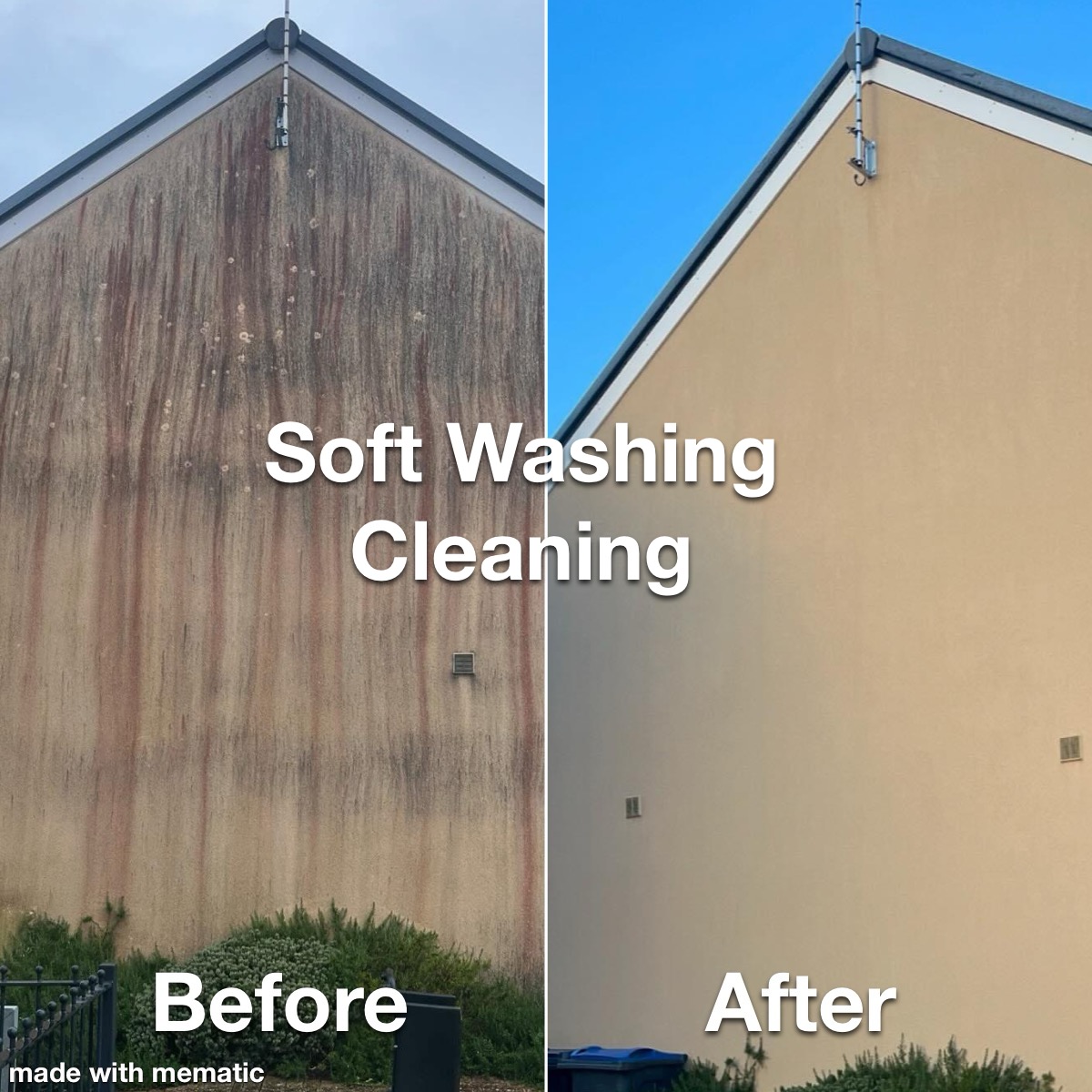
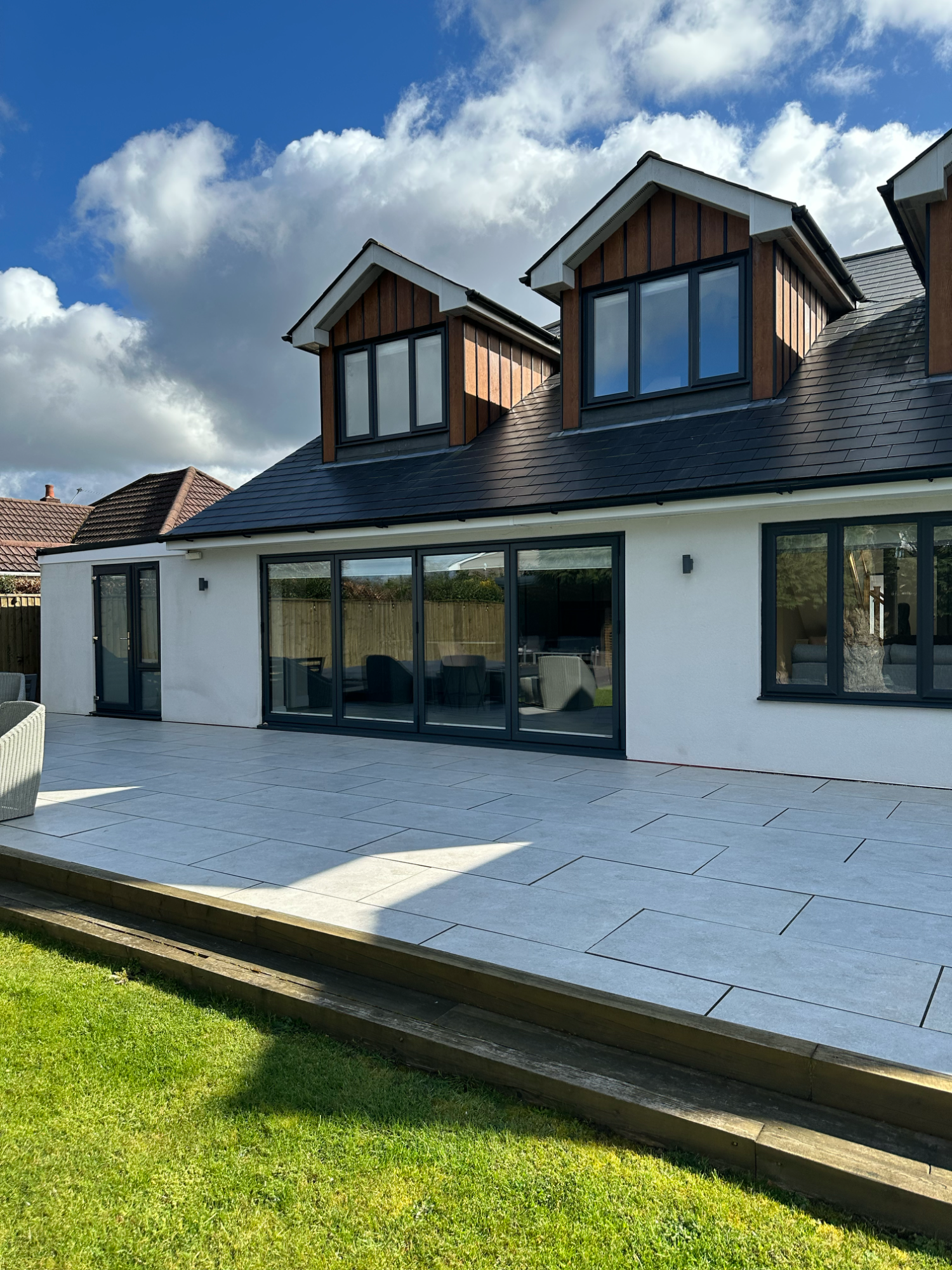
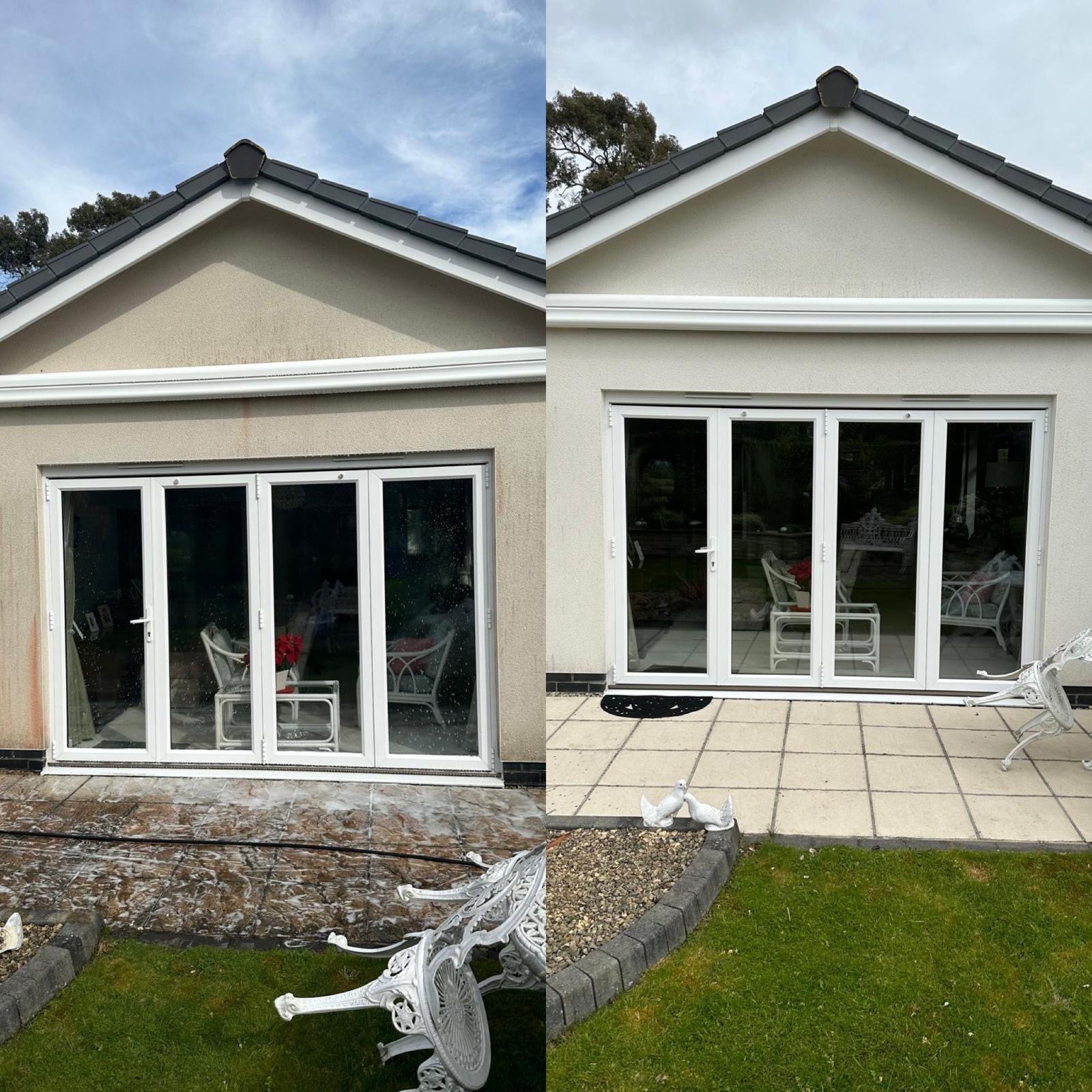
The most important thing to consider in my opinion is, will you do it yourself? or would you prefer an industry leading soft washing expert take care of it properly?
There is only one way to safely clean any type of through coloured render and that is to use a soft wash mix. A soft wash mix consists of 97% water, 2% sodium hypochlorite and 1% Green Wash. Combined and SPRAYED on (which brings Oxygen into the mix) kills off all organic matter which has infested the render. Once applied a dwell time of fifteen to twenty minutes is usually fine to give optimal clean results.
K-Rend render cleaning is safe when the correct soft wash method is used…
K-Rend render is designed to look clean, bright and modern, yet many UK homes see algae, staining and weathering long before they expect it.
If your walls are starting to look dull, patchy or green, you are not alone.
The good news is that K-Rend can be cleaned safely when the right soft wash method is used.
This guide explains exactly how to protect your render, avoid costly damage and keep your home looking fresh for years.
What Is K-Rend Render?
K-Rend is a silicone-based, through-coloured render used widely across the UK for its clean finish, breathability and weather resistance.
Although marketed as low-maintenance, K-Rend is not maintenance-free.
Exposure to moisture, shade, trees, coastal air and rainfall can all lead to algae growth and discolouration over time.
Understanding what K-Rend is made from helps explain why using the right soft wash method is essential.
Why Does K-Rend Get Dirty?
Most staining on K-Rend comes from algae, mould, moisture and airborne pollutants.
These start as small patches and gradually spread across shaded or damp walls.
Pressure washing forces water into the surface and can cause damage, which is why a controlled soft wash method is recommended.
Knowing the cause of the staining helps you understand the safest way to remove it.
How to Clean K-Rend Render Safely
K-Rend can be cleaned safely when the correct soft wash method is used.
The goal is simple. Remove algae, staining and organic growth without damaging the surface or forcing water into the render.
This is why we never use pressure washing on K-Rend. High pressure can strip the surface, cause cracking and drive moisture behind the render.
A proper K-Rend clean starts with understanding how the wall absorbs water.
Every project should begin with a porosity test.
This allows the cleaning technician to judge how the render reacts to moisture and ensures the solution is applied safely and evenly.
Once the surface is assessed, we apply a carefully prepared soft wash mix using low pressure.
This removes algae, mould and organic growth gently, allowing the render to return to a clean, bright and even finish.
Soft washing is the safest, most effective and most controlled method for cleaning K-Rend render on UK homes.
K Rend Render Cleaning
Step-by-Step: The Safe Way to Clean K-Rend Render
Cleaning K-Rend is not complicated, but it must be done correctly.
Here is the safe soft wash process used by trained render cleaning technicians on UK homes.
1. Initial Inspection
Every project begins with a visual inspection of the K-Rend surface.
We look for algae, black staining, patchiness, cracks, damaged areas and signs of water retention.
This helps us understand how the wall will respond to cleaning.
2. Porosity Test
A porosity test is essential for K-Rend.
It shows how quickly the render absorbs moisture and helps us choose the right strength of soft wash solution.
This protects the surface from over-saturation and ensures an even, consistent clean.
3. Preparing the Soft Wash Solution
For K-Rend, we use a carefully measured mix of sodium hypochlorite, water and surfactant.
This breaks down algae, mould and organic growth without damaging the render.
The mixture is always applied at low pressure.
4. Applying the Soft Wash Solution
The solution is sprayed gently onto the K-Rend wall.
There is no force, no blasting and no abrasion.
The soft wash mix begins working immediately, lifting stains and organic growth from the surface.
5. Allowing Time to Work
The solution needs time to dwell so it can reach into textured areas and remove deeper organic growth.
Dwell time varies depending on shading, contamination and weather conditions.
6. Rinsing and Final Clean
Once the solution has done its job, the wall is rinsed using low pressure.
This removes residue and reveals a cleaner, brighter K-Rend surface.
No pressure washing is ever used.
7. Optional: Hydrophobic Protective Coating
After cleaning, many homeowners choose to protect their K-Rend with a hydrophobic coating.
This helps prevent algae regrowth, reduces staining and keeps the render looking cleaner for longer.
You can learn more about this treatment on our
Hydrophobic Protective Coating page.
Following these steps ensures that K-Rend render is cleaned safely, effectively and without damage.
This method is trusted by homeowners who want long-lasting results without risking their property.
What NOT to Do When Cleaning K-Rend Render
K-Rend is strong, but it is not designed to withstand harsh cleaning methods.
Many homeowners unintentionally damage their render by using the wrong approach.
Here are the most common mistakes to avoid.
1. Do NOT Use a Pressure Washer
High-pressure cleaning can cause serious damage to K-Rend.
It forces water behind the render, strips the surface and creates cracking or blown sections.
K-Rend should only ever be cleaned using a controlled soft wash method.
2. Do NOT Use Bleach Straight From the Bottle
Household bleach is too strong and unpredictable.
It can cause patchiness, permanent discolouration and surface damage.
A professional soft wash uses a carefully measured sodium hypochlorite mix designed for exterior surfaces.
3. Do NOT Scrub the Render
Scrubbing can damage the texture of the render and spread stains.
K-Rend is not meant to be abraded.
Soft washing removes organic growth without physical force.
4. Do NOT Clean K-Rend Without a Porosity Test
A porosity test ensures the render absorbs moisture evenly.
Skipping this step can lead to streaking, uneven results and water retention in the surface.
Every professional K-Rend clean should begin with a porosity test.
5. Do NOT Use Random Chemicals
Some cleaning products react badly with silicone-based renders.
Only use approved soft wash solutions mixed at safe, controlled strengths.
The wrong chemical can cause long-term damage that cannot be reversed.
6. Do NOT Ignore Shaded or Damp Areas
Algae grows fastest on shaded or damp walls.
These areas need targeted treatment to prevent regrowth.
A full clean should treat all affected surfaces, not just the visible patches.
Avoiding these mistakes ensures your K-Rend stays clean, bright and structurally sound for years to come.
Common K-Rend Problems and How Soft Washing Fixes Them
K-Rend is a high-quality render, but like any exterior surface it can develop visible issues over time.
Most problems come from moisture, shade, organic growth or airborne pollutants.
Here are the most common issues homeowners see and how soft washing resolves them safely.
1. Green Algae Growth
Green algae is the most common problem on K-Rend, especially on shaded or north-facing walls.
Soft washing removes algae at the root and prevents rapid regrowth.
Pressure washing only removes the surface layer, meaning the algae returns quickly.
2. Black Mould or Black Streaking
Black staining happens when algae, moisture and pollutants build up over time.
It often looks worse than green growth but responds extremely well to soft washing.
The low-pressure chemical clean breaks down the organic material and restores a consistent colour.
3. Patchy or Uneven Colour
Patchiness usually appears when one area of the wall receives more shade or moisture than another.
Soft washing evens out the surface appearance by treating all affected zones thoroughly and consistently.
4. Red or Rust-Coloured Stains
Red staining is caused by a specific type of algae that thrives in moist conditions.
Soft wash treatment is the safest and most reliable way to remove it without damaging the silicone-based render.
5. Weathering and Dull Surfaces
Over time, K-Rend can lose its crisp, clean look due to pollution and environmental exposure.
Soft washing removes surface contaminants, brightens the finish and restores the “as new” appearance.
6. Moss Growth Near Ground Level
Where walls meet soil, pathways or planting areas, moss can develop.
Soft washing breaks down the moss structure and removes it gently without scraping or abrasion.
These issues are normal and predictable, and the good news is that soft washing is specifically designed to fix them safely.
How Often Should K-Rend Be Cleaned?
Most K-Rend surfaces benefit from a professional clean every two to three years.
Homes in shaded areas, coastal locations or properties surrounded by trees may need more frequent cleaning, sometimes every 12 to 18 months.
Sun exposure, moisture, airflow and rain patterns all affect how quickly algae grows.
The good news is that once K-Rend is cleaned using a safe soft wash method, it tends to stay bright for a long period.
Many homeowners choose to add a hydrophobic protective coating after cleaning, which reduces moisture absorption and slows down algae regrowth dramatically.
Regular maintenance not only keeps your home looking fresh, it also protects the render and helps extend its lifespan.
A simple soft wash clean at the right interval can save you thousands in unnecessary repairs.
Further Guidance for K-Rend Care
If you want to understand more about how K-Rend should be maintained, the manufacturer provides clear guidance on cleaning and long-term care.
Following these approved methods ensures your K-Rend render is looked after correctly and stays brighter for longer.
K-Rend Render Cleaning – Frequently Asked Questions
Can K-Rend be cleaned safely?
Yes. K-Rend can be cleaned safely using the correct soft wash method.
The key is low pressure, a controlled cleaning solution and a porosity test before starting.
Will soft washing damage my K-Rend?
No. Soft washing is the safest method for K-Rend when carried out by trained technicians.
It removes algae and staining without abrasion or water pressure.
Why is my K-Rend turning green?
Green staining is caused by algae growth in areas with moisture, shade or poor airflow.
Soft washing removes algae at the root and restores the original colour.
How long will my K-Rend stay clean?
Most homes stay clean for two to three years after a soft wash.
Adding a hydrophobic protective coating can extend this period further by reducing moisture absorption.
Can I pressure wash K-Rend?
No. Pressure washing can cause serious damage, including cracking, surface loss and water penetration behind the render.
It should never be used on K-Rend.
Why Choose Me?
⭐️ Professional
⭐️ Good communication
⭐️ Trained to use high pressure & soft washing equipment
⭐️ Trained to use chemicals
⭐️ Highly experienced
⭐️ £5 million liability insurance
⭐️ Full written quotes
⭐️ Trusted & reliable company
5 ⭐️ Reviews
Please contact me to discuss your requirements or request
a quote for any pressure washing or soft washing job.
All enquiries welcome
Contact Steve today
for a free no obligation Quote
What my customers say.
All 5 ⭐️ reviews are checked & published
by Google.
⭐️⭐️⭐️⭐️⭐️
I cannot recommend Steve at Mr Softwash Ltd highly enough. A very professional job done on our patio - paving slabs which hadn’t been cleaned for 4-5 years! They now look amazing and no mess left. My request for a quote was responded to quickly and he turned up at the date and time he said he would. Very happy customer 😊
Steve has soft washed my house and it was an excellent job. He's just come back and jet washed the driveway and resanded it and has done yet another excellent job. I highly recommend his work.
I can totally recommend Steve. We had our blocked drive and patio cleaned.Both came up as new.
Steve is prompt , efficient and takes pride in his work. Steve keeps you informed on everything he is doing and why.
It’s lovely to get such good service.
Excellent workmanship, highly recommend. Did front drive and large patio at rear, totally satisfied with all that was done. Thankyou Margaret
5 star service!
We got in touch with Steve after an accident with a large pot of green fence paint that exploded all over our block paved driveway! Steve was brilliant from start to finish, he cleaned our driveway, path at the front of our property and our Indian sandstone patio in the garden and has done a top job! All 3 areas look brand new, the paint has completely gone and its transformed the outside of our little house. Can’t rate Steve’s service highly enough. Professional, friendly and he’s done a brilliant job. Thank you!
I've just had my block paved Driveway cleaned and resanded by Steve at Mr Softwash Ltd...and I am chuffed to bits with it! It was in a right sorry state after a Massive Water leak restoration by Insurance builders, it had mould,Moss, water stains, builders rubble, tile grout, concrete you name it, it was on there!..and Now after he worked his magic, looks like it was laid yesterday. Pristine and all the colours are back and refreshed.
Steve was prompt, his work was clean and efficient, and he told me at every stage from estimate, to end of job why and how he was going to do job. I am extremely Happy with the Work carried out and would recommend this company to anyone!!
Thank you Mr Softwash Ltd!
Steve came this morning to clean my patio,he has done an amazing job. My patio has never looked so clean. Absolute professional and very reasonable prices.
Thank you Steve fantastic job.
Steve was friendly and efficient, doing a great job for us. He was also kind enough to look at some extra bits for me while he was here. Would recommend!
Positive
Responsiveness, Quality, Professionalism
Mr Softwash Ltd have recently pressure washed a patio, fascias and soffits for me, and the results are excellent.
Tags
K Render cleaning poole - K Render cleaning Bournemouth - K Render cleaning Christchurch - K Render cleaning Ringwood - K Render cleaning Wimborne - K Render cleaning Broadstone - K Render cleaning Corfe mullen - K Render cleaning Ferndown - K Render cleaning Swanage - K Render cleaning Dorset - K Render cleaning Wareham - K Render cleaning Blandford - K Render cleaning Dorchester - K Render cleaning West Parley - K Render cleaning Sandbanks - K Render cleaning Canford Cliffs - K Render cleaning Penn Hill - K Render cleaning Westbourne - K Render cleaning Talbot woods - K Render cleaning New forest - K Render cleaning Hamworthy - K Render cleaning Upton - K Render cleaning Branksome - K Render cleaning Creekmoor - K Render cleaning Canford Heath - K Render cleaning Sandford - K Render cleaning Bear cross - Render cleaning St Leonards - Render cleaning West moors - K Render cleaning Sturminster marshall - K Render cleaning Lytchett minster - K Render cleaning Lytchett matravers - K Render cleaning Southbourne - K Render cleaning Boscombe - K Render cleaning Whitecliff - K Render cleaning Lilliput - K Render cleaning Wallisdown - K Render cleaning Winton - K Render cleaning New Forest - K Render cleaning Corfe castle - K Render cleaning Weymouth - K Render cleaning Verwood - K Render cleaning West Moors - K Render cleaning Bridport - K Render cleaning Lymington - K Render cleaning Burley - K Render cleaning Highcliffe - K Render cleaning Fordingbridge - K Render cleaning Lyndhurst - K Render cleaning Brockenhurst - K Render cleaning New Milton - K Render cleaning Bransgore - K Render cleaning Milford on sea - K Render cleaning Beaulieu - K Render cleaning Totten - K Render cleaning Romsey - K Render cleaning Southampton - K Render cleaning Salisbury - K Render cleaning Winchester - K Render cleaning Spetisbury - K Render cleaning Charlton Marshall - K Render cleaning Bere Regis - K Render cleaning Bovington - K Render cleaning Shaftesbury - K Render cleaning Parkstone - K Render cleaning Three legged cross - K Render cleaning Wool - K Render cleaning Poole - K Render cleaning Bournemouth - K Render cleaning Christchurch - K Render cleaning Ringwood - K Render cleaning Ferndown - K Render cleaning Broadstone - K Render cleaning Wimborne - K Render cleaning Corfe Mullen - K Render cleaning Wareham - K Render cleaning Dorset - K Render cleaning Sandford - K Render cleaning Blandford - K Render cleaning Corfe Castle - K Render cleaning Swanage - K Render cleaning Ashley Heath - K Rend cleaning Poole - K Rend cleaning Bournemouth - K Rend cleaning Christchurch - K Rend cleaning Ringwood - K Rend cleaning Verwood - K Rend cleaning Ferndown - K Rend cleaning Wimborne - K Rend cleaning Broadstone - K Rend cleaning Corfe Mullen - K Rend cleaning Wareham - K Rend cleaning Swanage - K Rend cleaning Weymouth - K Rend cleaning Dorchester - K Rend cleaning Blandford - K Rend cleaning New Forest - K Rend cleaning New Milton - K Rend cleaning Southampton - K Rend cleaning Romsey - Soft washing Poole - Soft washing Bournemouth - Soft washing Christchurch - Soft washing Ringwood - Soft washing Verwood - Soft washing Ferndown - Soft washing Wimborne - Soft washing Broadstone - Soft washing Corfe Mullen - Soft washing Sandford - Soft washing Wareham - Soft washing Swanage - Soft washing Dorchester - Soft washing Blandford - Soft washing Sturminster Marshall - Soft washing Lytchett Matravers - Soft washing Upton - Soft washing Hamworthy - Soft washing New Forest -Wareham - Pressure washing Blandfrord - Soft washing Sandbanks - Soft washing Canford Cliffs - Soft washing Penn Hill - Soft washing Westbourne - Soft washing Talbot woods - Soft washing New forest - Soft washing Hamworthy - Soft washing Upton - Soft washing Branksome - Soft washing Creekmoor - Soft washing Canford Heath - Soft washing Sandford - Soft washing Bear cross - Soft washing St Leonards - Soft washing West moors - Soft washing Sturminster marshall - Soft washing Lytchett minster - Soft washing Lytchett matravers - Soft washing Southbourne - Soft washing Boscombe - Soft washing Whitecliff - Soft washing Lilliput - Soft washing Wallisdown - Soft washing Winton - Soft washing New Forest - Soft washing Corfe castle - Soft washing Weymouth - Soft washing Bridport - Soft washing Lymington - Soft washing Burley - Soft washing Highcliffe - Soft washing Fordingbridge - Soft washing Lyndhurst - Soft Washing Brockenhurst - Soft washing New Milton - Soft washing Bransgore - Soft washing Milford on sea - Soft washing Beaulieu - Soft washing Totten - Soft washing Romsey - Soft washing Southampton - Soft washing Salisbury - Soft washing Winchester - Soft washing Spetisbury - Soft washing Charlton Marshall - Soft washing Bere Regis - Soft washing Bovington - Soft washing Shaftesbury - Soft washing Parkstone - Soft washing Three legged cross - Soft washing Wool
We need your consent to load the translations
We use a third-party service to translate the website content that may collect data about your activity. Please review the details in the privacy policy and accept the service to view the translations.